


Page 740 - ACCCN's Critical Care Nursing
P. 740
Pregnancy and Postpartum Considerations 717


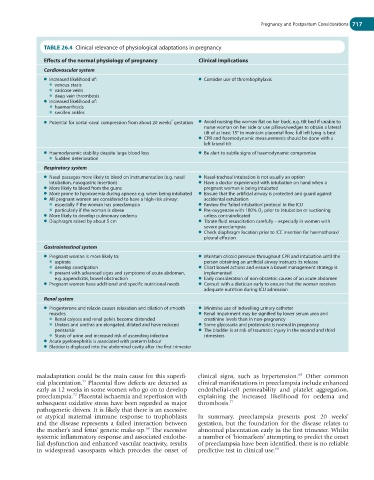
               TABLE 26.4  Clinical relevance of physiological adaptations in pregnancy

               Effects of the normal physiology of pregnancy      Clinical implications
               Cardiovascular system
               l  Increased likelihood of:                        l  Consider use of thrombophylaxis
                 l  venous stasis
                 l  varicose veins
                 l  deep vein thrombosis
               l  Increased likelihood of:
                 l  haemorrhoids
                 l  swollen ankles
               l  Potential for aortal-caval compression from about 20 weeks’ gestation  l  Avoid nursing the woman flat on her back, e.g. tilt bed if unable to
                                                                    nurse woman on her side or use pillows/wedges to obtain a lateral
                                                                    tilt of at least 15° to maintain placental flow, full left lying is best
                                                                  l  CPR and haemodynamic measurements should be done with a
                                                                    left lateral tilt
               l  Haemodynamic stability despite large blood loss  l  Be alert to subtle signs of haemodynamic compromise
                 l  Sudden deterioration
               Respiratory system
               l  Nasal passages more likely to bleed on instrumentation (e.g. nasal   l  Nasal-tracheal intubation is not usually an option
                 intubation, nasogastric insertion)               l  Have a doctor experienced with intubation on hand when a
               l  More likely to bleed from the gums                pregnant woman is being intubated
               l  More prone to hypoxaemia during apnoea e.g. when being intubated  l  Ensure that the artificial airway is protected and guard against
               l  All pregnant women are considered to have a high-risk airway:  accidental extubation
                 l  especially if the woman has preeclampsia      l  Review the ‘failed intubation’ protocol in the ICU
                 l  particularly if the woman is obese            l  Pre-oxygenate with 100% O 2  prior to intubation or suctioning
               l  More likely to develop pulmonary oedema           unless contraindicated
               l  Diaphragm raised by about 5 cm                  l  Titrate fluid resuscitation carefully – especially in women with
                                                                    severe preeclampsia
                                                                  l  Check diaphragm location prior to ICC insertion for haemothorax/
                                                                    pleural effusion
               Gastrointestinal system
               l  Pregnant woman is more likely to:               l  Maintain cricoid pressure throughout CPR and intubation until the
                 l  aspirate                                        person obtaining an artificial airway instructs its release
                 l  develop constipation                          l  Chart bowel actions and ensure a bowel management strategy is
                 l  present with advanced signs and symptoms of acute abdomen,   implemented
                   e.g. appendicitis, bowel obstruction           l  Early consideration of non-obstetric causes of an acute abdomen
               l  Pregnant women have additional and specific nutritional needs  l  Consult with a dietician early to ensure that the woman receives
                                                                    adequate nutrition during ICU admission
               Renal system
               l  Progesterone and relaxin causes relaxation and dilation of smooth   l  Minimise use of indwelling urinary catheter
                 muscles                                          l  Renal impairment may be signified by lower serum urea and
                 l  Renal calyces and renal pelvis become distended  creatinine levels than in non-pregnancy
                 l  Ureters and urethra are elongated, dilated and have reduced   l  Some glycosuria and proteinuria is normal in pregnancy
                   peristalsis                                    l  The bladder is at risk of traumatic injury in the second and third
                 l  Stasis of urine and increased risk of ascending infection  trimesters
               l  Acute pyelonephritis is associated with preterm labour
               l  Bladder is displaced into the abdominal cavity after the first trimester


                                                                                                   68
             maladaptation could be the main cause for this superfi-  clinical  signs,  such  as  hypertension.   Other  common
                            71
             cial placentation.  Placental flow defects are detected as   clinical manifestations in preeclampsia include enhanced
             early as 12 weeks in some women who go on to develop   endothelial-cell  permeability  and  platelet  aggregation,
                         72
             preeclampsia.  Placental ischaemia and reperfusion with   explaining  the  increased  likelihood  for  oedema  and
             subsequent oxidative stress have been regarded as major   thrombosis. 71
             pathogenetic drivers. It is likely that there is an excessive
             or  atypical  maternal  immune  response  to  trophoblasts   In  summary,  preeclampsia  presents  post  20  weeks’
             and  the  disease  represents  a  failed  interaction  between   gestation,  but  the  foundation  for  the  disease  relates  to
                                                 68
             the mother’s and fetus’ genetic make-up.  The excessive   abnormal placentation early in the first trimester. Whilst
             systemic inflammatory response and associated endothe-  a number of ‘biomarkers’ attempting to predict the onset
             lial dysfunction and enhanced vascular reactivity, results   of preeclampsia have been identified, there is no reliable
             in  widespread  vasospasm  which  precedes  the  onset  of   predictive test in clinical use. 68

