


Page 746 - ACCCN's Critical Care Nursing
P. 746
Pregnancy and Postpartum Considerations 723

             Severe Obstetric Haemorrhage                         complicates  fluid  resuscitation. 100,101   Standard  resuscita-
             Management Priorities                                tion  fluids,  such  as  normal  saline,  should  be  infused
             Whilst  it  is  feasible  for  a  pregnant  woman  in  ICU     according to routine practice of the non-obstetric haem-
             to  develop  placental  abruption,  for  example,  the  vast   orrhage, remembering that large volumes of blood prod-
             majority  of  women  admitted  to  ICU  with  obstetric    ucts may also be required.
             haemorrhage  will  be  transferred  following  birth,  and
             are  thus  postpartum  on  admission  to  ICU.  These
             priorities  focus  on  postpartum  management.  As  with
             any major haemorrhage (see Chapter 20), the principles   Practice tip
             of  treatment  are:
                                                                    Keep in mind that:
             l  restore an adequate circulating volume and maintain
                oxygen and perfusion to vital organs                l  Serum albumin levels are decreased in normal pregnancy,
                                                                                                                46
             l  obtain haemostasis and correct coagulopathy            with the lowest levels recorded in the postpartum period.
             l  prevent complications.                              l  Cardiac output remains elevated postpartum for the first
                                                                       few days at least.
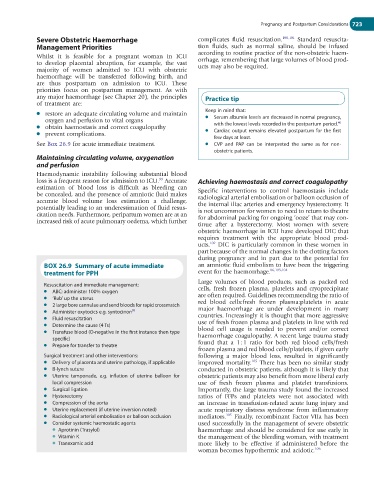
             See Box 26.9 for acute immediate treatment.            l  CVP  and  PAP  can  be  interpreted  the  same  as  for  non-
                                                                       obstetric patients.
             Maintaining circulating volume, oxygenation
             and perfusion
             Haemodynamic  instability  following  substantial  blood
                                                     99
             loss is a frequent reason for admission to ICU.  Accurate   Achieving haemostasis and correct coagulopathy
             estimation  of  blood  loss  is  difficult  as  bleeding  can     Specific  interventions  to  control  haemostasis  include
             be concealed, and the presence of amniotic fluid makes   radiological arterial embolisation or balloon occlusion of
             accurate  blood  volume  loss  estimation  a  challenge,   the internal iliac arteries and emergency hysterectomy. It
             potentially leading to an underestimation of fluid resus-  is not uncommon for women to need to return to theatre
             citation needs. Furthermore, peripartum women are at an   for abdominal packing for ongoing ‘ooze’ that may con-
             increased risk of acute pulmonary oedema, which further
                                                                  tinue  after  a  hysterectomy.  Most  women  with  severe
                                                                  obstetric haemorrhage in ICU have developed DIC that
                                                                  requires  treatment  with  the  appropriate  blood  prod-
                                                                  ucts.  DIC is particularly common in these women in
                                                                      102
                                                                  part because of the normal changes in the clotting factors
                                                                  during  pregnancy  and  in  part  due  to  the  potential  for
               BOX 26.9  Summary of acute immediate               an amniotic fluid embolism to have been the triggering
               treatment for PPH                                  event for the haemorrhage. 86,103,104
                                                                  Large  volumes  of  blood  products,  such  as  packed  red
               Resuscitation and immediate management:
               l  ABC; administer 100% oxygen                     cells,  fresh  frozen  plasma,  platelets  and  cryoprecipitate
               l  ‘Rub’ up the uterus                             are often required. Guidelines recommending the ratio of
               l  2 large bore cannulae and send bloods for rapid crossmatch  red  blood  cells:fresh  frozen  plasma:platelets  in  acute
               l  Administer oxytocics e.g. syntocinon 98         major  haemorrhage  are  under  development  in  many
               l  Fluid resuscitation                             countries. Increasingly it is thought that more aggressive
               l  Determine the cause (4 Ts)                      use of fresh frozen plasma and platelets in line with red
               l  Transfuse blood (O-negative in the first instance then type   blood  cell  usage  is  needed  to  prevent  and/or  correct
                  specific)                                       haemorrhage coagulopathy. A recent large trauma study
               l  Prepare for transfer to theatre                 found  that  a  1 : 1  ratio  for  both  red  blood  cells/fresh
                                                                  frozen plasma and red blood cells/platelets, if given early
               Surgical treatment and other interventions:        following  a  major  blood  loss,  resulted  in  significantly
                                                                                   105
               l  Delivery of placenta and uterine pathology, if applicable  improved mortality.  There has been no similar study
               l  B-lynch suture                                  conducted in obstetric patients, although it is likely that
               l  Uterine  tamponade,  e.g.  inflation  of  uterine  balloon  for   obstetric patients may also benefit from more liberal early
                  local compression                               use  of  fresh  frozen  plasma  and  platelet  transfusions.
               l  Surgical ligation                               Importantly, the large trauma study found the increased
               l  Hysterectomy                                    ratios  of  FFPs  and  platelets  were  not  associated  with
               l  Compression of the aorta                        an increase in transfusion-related acute lung injury and
               l  Uterine replacement (if uterine inversion noted)  acute  respiratory  distress  syndrome  from  inflammatory
                                                                           105
               l  Radiological arterial embolisation or balloon occlusion  mediators.   Finally,  recombinant  Factor  VIIa  has  been
               l  Consider systemic haemostatic agents            used successfully in the management of severe obstetric
                  l  Aprotinin (Trasylol)                         haemorrhage and should be considered for use early in
                  l  Vitamin K                                    the management of the bleeding woman, with treatment
                  l  Tranexamic acid                              more  likely  to  be  effective  if  administered  before  the
                                                                  woman becomes hypothermic and acidotic. 106

