


Page 745 - ACCCN's Critical Care Nursing
P. 745
722  S P E C I A LT Y   P R A C T I C E   I N   C R I T I C A L   C A R E


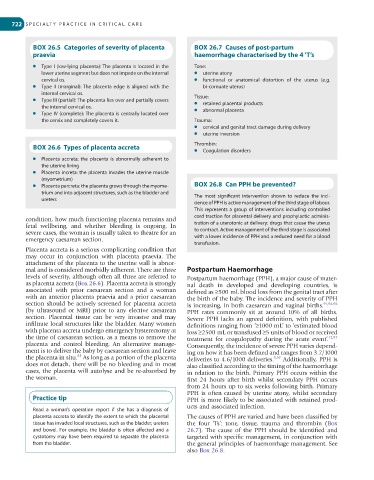
            BOX 26.5  Categories of severity of placenta         BOX 26.7  Causes of post-partum
            praevia                                              haemorrhage characterised by the 4 ‘T’s

            l  Type I (low-lying placenta): The placenta is located in the   Tone:
               lower uterine segment but does not impede on the internal   l  uterine atony
               cervical os.                                      l  functional  or  anatomical  distortion  of  the  uterus  (e.g.
            l  Type  II  (marginal): The  placenta  edge  is  aligned  with  the   bi-cornuate uterus)
               internal cervical os.                             Tissue:
            l  Type III (partial): The placenta lies over and partially covers   l  retained placental products
               the internal cervical os.                         l  abnormal placenta
            l  Type IV (complete): The placenta is centrally located over
               the cervix and completely covers it.              Trauma:
                                                                 l  cervical and genital tract damage during delivery
                                                                 l  uterine inversion
            BOX 26.6  Types of placenta accreta                  Thrombin:
                                                                 l  Coagulation disorders
            l  Placenta  accreta:  the  placenta  is  abnormally  adherent  to
               the uterine lining
            l  Placenta increta: the placenta invades the uterine muscle
               (myometrium)
            l  Placenta percreta: the placenta grows through the myome-  BOX 26.8  Can PPH be prevented?
               trium and into adjacent structures, such as the bladder and   The  most  significant  intervention  shown  to  reduce  the  inci-
               ureters
                                                                 dence of PPH is active management of the third stage of labour.
                                                                 This represents a group of interventions including controlled
                                                                 cord traction for placental delivery and prophylactic adminis-
         condition, how much functioning placenta remains and
         fetal  wellbeing,  and  whether  bleeding  is  ongoing.  In   tration of a uterotonic at delivery: drugs that cause the uterus
         severe cases, the woman is usually taken to theatre for an   to contract. Active management of the third stage is associated
         emergency caesarean section.                            with a lower incidence of PPH and a reduced need for a blood
                                                                 transfusion.
         Placenta accreta is a serious complicating condition that
         may  occur  in  conjunction  with  placenta  praevia.  The
         attachment of the placenta to the uterine wall is abnor-
         mal and is considered morbidly adherent. There are three   Postpartum Haemorrhage
         levels of severity, although often all three are referred to   Postpartum haemorrhage (PPH), a major cause of mater-
         as placenta accreta (Box 26.6). Placenta accreta is strongly   nal  death  in  developed  and  developing  countries,  is
         associated  with  prior  caesarean  section  and  a  woman   defined as ≥500 mL blood loss from the genital tract after
         with an anterior placenta praevia and a prior caesarean   the birth of the baby. The incidence and severity of PPH
         section should be actively screened for placenta accreta   is increasing, in both caesarean and vaginal births. 91,94-96
         (by  ultrasound  or  MRI)  prior  to  any  elective  caesarean   PPH  rates  commonly  sit  at  around  10%  of  all  births.
         section.  Placental  tissue  can  be  very  invasive  and  may   Severe  PPH  lacks  an  agreed  definition,  with  published
         infiltrate local structures like the bladder. Many women   definitions ranging from ‘≥1000 mL’ to ‘estimated blood
         with placenta accreta undergo emergency hysterectomy at   loss ≥2500 mL or transfused ≥5 units of blood or received
         the time of caesarean section, as a means to remove the   treatment  for  coagulopathy  during  the  acute  event’. 12,97
         placenta  and  control  bleeding.  An  alternative  manage-  Consequently, the incidence of severe PPH varies depend-
         ment is to deliver the baby by caesarean section and leave   ing on how it has been defined and ranges from 3.7/1000
         the placenta in situ.  As long as a portion of the placenta   deliveries to 4.6/1000 deliveries. 5,97  Additionally, PPH is
                          93
         does not detach, there will be no bleeding and in most   also classified according to the timing of the haemorrhage
         cases, the placenta will autolyse and be re-absorbed by   in relation to the birth. Primary PPH occurs within the
         the woman.                                           first  24  hours  after  birth  whilst  secondary  PPH  occurs
                                                              from 24 hours up to six weeks following birth. Primary
                                                              PPH is often caused by uterine atony, whilst secondary
            Practice tip                                      PPH is more likely to be associated with retained prod-
                                                              ucts and associated infection.
            Read  a  woman’s  operation  report  if  she  has  a  diagnosis  of
            placenta accreta to identify the extent to which the placental   The causes of PPH are varied and have been classified by
            tissue has invaded local structures, such as the bladder, ureters   the  four  ‘Ts’:  tone,  tissue,  trauma  and  thrombin  (Box
            and  bowel.  For  example,  the  bladder  is  often  affected  and  a   26.7).  The  cause  of  the  PPH  should  be  identified  and
            cystotomy may have been required to separate the placenta   targeted with specific management, in conjunction with
            from the bladder.                                 the general principles of haemorrhage management. See
                                                              also Box 26.8.

