


Page 779 - ACCCN's Critical Care Nursing
P. 779
756  S P E C I A LT Y   P R A C T I C E   I N   C R I T I C A L   C A R E


            TABLE 27.8  Blood tests required for organ           BOX 27.2  Medical management of
            donation 58,72,87,88,89                              the potential donor 76

            Measurement required Test                            Referral:
                                                                 l  Refer all potential organ donors to the local State DonateLife
            Serology            l  HIV I and II
                                l  HTLV 1 antibody                 agency, even if uncertain of medical suitability. Criteria for
                                l  Hepatitis B sAg                 suitability change over time and vary according to recipient
                                l  Hepatitis B sAb                 circumstances.
                                l  Hepatitis B Core Ab
                                l  Hepatitis C sAb               Medical management:
                                l  CMV (IgG)                     l  Maintain MAP > 70 mmHg: maintain euvolaemia, if required
                                l  EBV (excluding NSW)             administer inotropic agents (e.g. noradrenaline)
                                l  Syphilis (excluding SA)       l  Maintain adequate organ perfusion (monitor urine output,
                                l  Toxoplasma IgG and IgM (SA, NT
                                  and WA only)                     lactate), consider invasive haemodynamic monitoring
                                                                                      +
                                                                                    +
                                l  HSV (WA only)                 l  Monitor electrolytes (Na , K ) every 2 to 4 hours and correct
                                                                   to normal range
            NAT screen (nucleic    This is not routinely performed on
             acid test)          all donors. Testing is currently   l  Suspected diabetes insipidus (UO >200 mL/h, rising serum
                                 only available through the        sodium):  administer  DDAVP  (e.g.  4 mcg IV  in  adults)  and
                                 Australian Red Cross Blood        replace volume loss with 5% dextrose
                                 Service. The State Donatelife   l  Treat hyperglycaemia (actrapid infusion): aim blood glucose
                                 Coordinator facilitates the
                                 process.                          5 to 8 mmol/L
                                l  HIV NAT Screen (VIC and NSW   l  Keep  temp  >35°C.  Pre-emptive  use  of  warming  blankets
                                  routinely test)                  etc is advised as hypothermia may be difficult to reverse
                                l  HCV NAT Screen (VIC and NSW     once it has developed
                                  routinely test)                l  Provide  ongoing  respiratory  care  (frequent  suctioning,
            Tissue typing       Crossmatching with the blood of    positioning/turning, PEEP, recruitment manoeuvres)
                                 potential recipients of relevant   l  Maintain haemoglobin >80 g/L
                                 ABO
                                                                 Hormone replacement therapy:
                                                                 The use of hormonal replacement therapy remains controver-
                                                                 sial. Some centres use it in the setting of persistent haemody-
         recipient’s  serum  to  test  whether  the  recipient  has  an   namic instability (despite volume resuscitation and low dose
         antibody  that  is  specific  to  the  donor’s  HLA  antigens.    inotropes) and/or if cardiac ejection fraction <45%. Typical regi-
         A  positive  crossmatch  reaction,  where  the  recipient’s   mens include:
         serum  destroys  the  donor’s  cells,  is  a  contraindication     l  triiodothyronine (T3): 4 mcg IV bolus, then 3 mcg/h by IV
         for transplantation. 58                                   infusion
                                                                 l  arginine vasopressin (AVP): 0.5 to 4.0 U/h to maintain MAP
         DONOR MANAGEMENT                                          70 mmHg
         The fourth factor influencing the number of actual organ   l  methylprednisolone: 15 mg/kg IV single bolus.
         donors  is  the  clinical  management  that  the  donor  and
         family  receive  after  confirmation  of  death.  The  aim  of
         donor  management  is  to  support  and  optimise  organ
         function  until  organ  retrieval  commences,  while  main-  will bring most of their specialised equipment with them.
         taining dignity and respect for the donor and support for   An  anaesthetist  monitors  haemodynamics,  ventilation
         the family. All aspects of ICU treatment, apart from brain-  and administers medications, which may include a long-
         oriented therapy, should continue until it is certain that   acting muscle relaxant given prior to the surgical proce-
                                      13
         organ  donation  will  not  occur.   Ideal  parameters  for   dure,  to  prevent  interference  in  the  surgical  process  by
         biochemistry,  vital  signs,  and  urine  output  and  clinical   spinal reflexes, only after consultation with the retrieval
                                                                   58
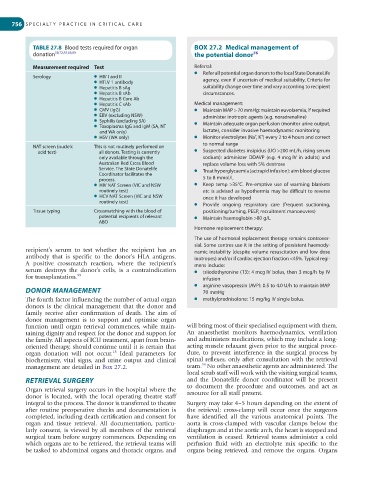
         management are detailed in Box 27.2.                 team.  No other anaesthetic agents are administered. The
                                                              local scrub staff will work with the visiting surgical teams,
         RETRIEVAL SURGERY                                    and  the  Donatelife  donor  coordinator  will  be  present
         Organ retrieval surgery occurs in the hospital where the   to  document  the  procedure  and  outcomes,  and  act  as
                                                              resource for all staff present.
         donor  is  located,  with  the  local  operating  theatre  staff
         integral to the process. The donor is transferred to theatre   Surgery may take 4–5 hours depending on the extent of
         after routine preoperative checks and documentation is   the  retrieval;  cross-clamp  will  occur  once  the  surgeons
         completed, including death certification and consent for   have  identified  all  the  various  anatomical  points.  The
         organ  and  tissue  retrieval.  All  documentation,  particu-  aorta  is  cross-clamped  with  vascular  clamps  below  the
         larly consent, is viewed by all members of the retrieval   diaphragm and at the aortic arch, the heart is stopped and
         surgical team before surgery commences. Depending on   ventilation  is  ceased.  Retrieval  teams  administer  a  cold
         which organs are to be retrieved, the retrieval teams will   perfusion  fluid  with  an  electrolyte  mix  specific  to  the
         be tasked to abdominal organs and thoracic organs, and   organs  being  retrieved,  and  remove  the  organs.  Organs

