


Page 81 - ACCCN's Critical Care Nursing
P. 81
58  S C O P E   O F   C R I T I C A L   C A R E

                                                              recovering from Acute Lung Injury/Adult Respiratory Dis-
                   Pre-ICU
                                       Post-hospital
                        ICU
                              Ward
                                                                            29-31
                                                                                A related factor is nutrition, with one
                                                              tress Syndrome.
              Disease burden                                  study noting that 39% of patients post-ICU had little or
                                                              no appetite and 15% were still receiving either a soft diet
                                                                                           32
                                                              or tube feeding while in hospital.
                                                              Clinical assessment includes identification of generalised
                                                 Time         CLINICAL ASSESSMENT
                                                              weakness following the onset of a critical illness, exclu-
                        Burden of critical illness            sion of other diagnoses (e.g. Guillain–Barré syndrome),
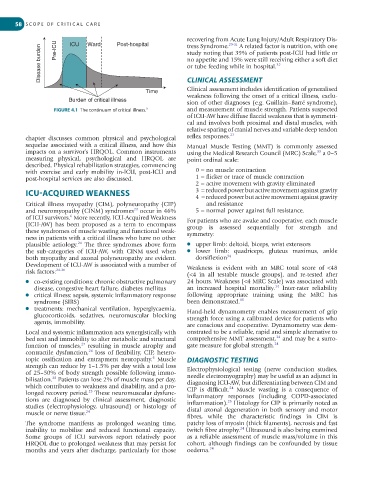
                   FIGURE 4.1  The continuum of critical illness.   9  and measurement of muscle strength. Patients suspected
                                                              of ICU-AW have diffuse flaccid weakness that is symmetri-
                                                              cal and involves both proximal and distal muscles, with
                                                              relative sparing of cranial nerves and variable deep tendon
         chapter  discusses  common  physical  and  psychological   reflex responses. 23
         sequelae associated with a critical illness, and how this   Manual  Muscle  Testing  (MMT)  is  commonly  assessed
         impacts on a survivor’s HRQOL. Common instruments    using the Medical Research Council (MRC) Scale,  a 0–5
                                                                                                         33
         measuring  physical,  psychological  and  HRQOL  are   point ordinal scale:
         described. Physical rehabilitation strategies, commencing
         with  exercise  and  early  mobility  in-ICU,  post-ICU  and   0 = no muscle contraction
         post-hospital services are also discussed.              1 = flicker or trace of muscle contraction
                                                                 2 = active movement with gravity eliminated
         ICU-ACQUIRED WEAKNESS                                   3  = reduced power but active movement against gravity
                                                                 4  = reduced power but active movement against gravity
         Critical  illness  myopathy  (CIM),  polyneuropathy  (CIP)   and resistance
                                             23
         and neuromyopathy (CINM) syndromes  occur in 46%        5 = normal power against full resistance.
         of ICU survivors.  More recently, ICU-Acquired Weakness   For patients who are awake and cooperative, each muscle
                        6
         (ICU-AW)  has  been  proposed  as  a  term  to  encompass   group  is  assessed  sequentially  for  strength  and
         these syndromes of muscle wasting and functional weak-  symmetry:
         ness in patients with a critical illness who have no other
                          24
         plausible  aetiology.   The  three  syndromes  above  form   ●  upper limb: deltoid, biceps, wrist extensors
         the  sub-categories  of  ICU-AW,  with  CINM  used  when   ●  lower  limb:  quadriceps,  gluteus  maximus,  ankle
         both myopathy and axonal polyneuropathy are evident.    dorsiflexion 34
         Development of ICU-AW is associated with a number of   Weakness  is  evident  with  an  MRC  total  score  of  <48
         risk factors: 24-26
                                                              (<4  in  all  testable  muscle  groups),  and  re-tested  after
         ●  co-existing conditions: chronic obstructive pulmonary   24 hours. Weakness (<4 MRC Scale) was associated with
                                                                                           34
            disease, congestive heart failure, diabetes mellitus  an  increased  hospital  mortality.   Inter-rater  reliability
         ●  critical illness: sepsis, systemic inflammatory response   following  appropriate  training  using  the  MRC  has
            syndrome (SIRS)                                   been demonstrated. 35
         ●  treatments:  mechanical  ventilation,  hyperglycaemia,   Hand-held  dynamometry  enables  measurement  of  grip
            glucocorticoids,  sedatives,  neuromuscular  blocking   strength force using a calibrated device for patients who
            agents, immobility.                               are conscious and cooperative. Dynamometry was dem-
         Local and systemic inflammation acts synergistically with   onstrated to be a reliable, rapid and simple alternative to
                                                                                           34
         bed rest and immobility to alter metabolic and structural   comprehensive MMT assessment,  and may be a surro-
                            27
         function  of  muscles,   resulting  in  muscle  atrophy  and   gate measure for global strength. 24
                              26
         contractile dysfunction,  loss of flexibility, CIP, hetero-
         topic  ossification  and  entrapment  neuropathy.   Muscle   DIAGNOSTIC TESTING
                                                   6
         strength can reduce by 1–1.5% per day with a total loss
         of 25–50% of body strength possible following immo-  Electrophysiological  testing  (nerve  conduction  studies,
         bilisation.  Patients can lose 2% of muscle mass per day,   needle electromyography) may be useful as an adjunct in
                  28
         which contributes to weakness and disability, and a pro-  diagnosing ICU-AW, but differentiating between CIM and
                                                                            24
                              25
         longed recovery period.  These neuromuscular dysfunc-  CIP  is  difficult.   Muscle  wasting  is  a  consequence  of
         tions  are  diagnosed  by  clinical  assessment,  diagnostic   inflammatory  responses  (including  COPD-associated
                                                                           25
         studies  (electrophysiology,  ultrasound)  or  histology  of   inflammation).  Histology for CIP is primarily noted as
         muscle or nerve tissue. 24                           distal  axonal  degeneration  in  both  sensory  and  motor
                                                              fibres,  while  the  characteristic  findings  in  CIM  is
         The  syndrome  manifests  as  prolonged  weaning  time,   patchy loss of myosin (thick filaments), necrosis and fast
                                                                                24
         inability  to  mobilise  and  reduced  functional  capacity.   twitch fibre atrophy.  Ultrasound is also being examined
         Some  groups  of  ICU  survivors  report  relatively  poor   as a reliable assessment of muscle mass/volume in this
         HRQOL due to prolonged weakness that may persist for   cohort, although findings can be confounded by tissue
         months and years after discharge, particularly for those   oedema. 24

