


Page 82 - ACCCN's Critical Care Nursing
P. 82
Recovery and Rehabilitation 59

                                                                  HRQOL instruments available is large, but can be divided
               Practice tip                                       into two groups: generic to all illnesses, or specific to a
                                                                  particular disease state. One limitation of generic instru-
               Current  clinical  recommendations  to  limit  muscle  wasting   ments is that, while they can be applied to a broad spec-
               include:                                           trum  of  populations,  they  may  not  be  responsive  to
               ●  minimising patient exposure to corticosteroids and neuro-  specific disease characteristics.  This section discusses the
                                                                                            43
                  muscular blocking agents                        measurement of health outcomes, focusing on HRQOL,
               ●  limiting excessive analgesia and sedation       and the physical and psychological measures commonly
               ●  glycaemic control may also be of value, although further   used to assess survivors of a critical illness.
                  investigations continue
               ●  early nutrition or specific nutritional supplements or com-  As introduced earlier, reviews of numerous observational
                  ponents may limit loss of muscle mass or enhance muscle   studies  with  survivors  of  a  critical  illness  have  demon-
                  recovery, but also requires further research. 25  strated a delayed recovery trajectory, highlighting particu-
                                                                  larly  the  effect  of  physical  function  on  an  individual’s
                                                                  usual  role.  Recommendations  for  future  studies  noted
                                                                  that patients should be followed for at least six months,
             PATIENT OUTCOMES FOLLOWING                           have  neuropsychological  testing  as  part  of  their  assess-
                                                                  ment, and be assessed using a HRQOL instrument that
             A CRITICAL ILLNESS                                   enables comparison across countries and languages. 3,9,44,45
                                                                  Common  instruments  used  to  assess  HRQOL,  physical
             Examination of patient outcomes beyond survival is an
             important  contemporary  topic  for  critical  care  practice   functioning and psychological functioning for cohorts of
             and research. 3-5,36  Patient outcomes after a critical illness   patients after a critical illness are discussed below.
             or injury were traditionally measured using a number of
             objective  parameters  (e.g.  number  of  organ  failure-free   MEASURES OF HEALTH-RELATED QUALITY OF
                                                  37
             days,  28-day  status,  or  1-year  mortality).   Other  mea-  LIFE AFTER A CRITICAL ILLNESS
             sures  that  examined  patient-centred  concepts  such  as   A generic instrument that measures baseline HRQOL and
             functional  status  and  HRQOL 38,39   have  become  more   exhibits responsiveness in a recovering critically ill patient
             prevalent in the literature. 3,4,40-42  As the recovery trajectory   with  demonstrated  reliability  and  validity  has  been
             from  a  critical  illness  may  be  long  and  incomplete,   elusive,  although  recent  review  papers  have  identified
                                                                                        4,9
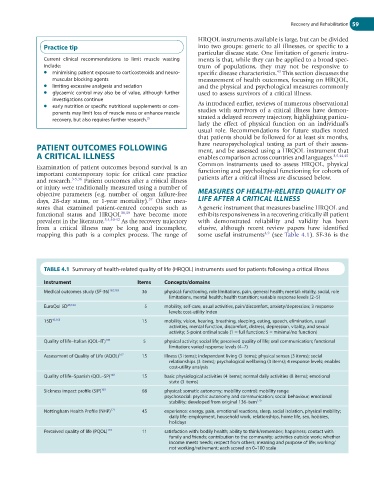
             mapping  this  path  is  a  complex  process.  The  range  of   some useful instruments  (see Table 4.1). SF-36 is the


               TABLE 4.1  Summary of health-related quality of life (HRQOL) instruments used for patients following a critical illness

               Instrument                     Items    Concepts/domains
               Medical outcomes study (SF-36) 162,163  36  physical: functioning, role limitations, pain, general health; mental: vitality, social, role
                                                        limitations, mental health; health transition; variable response levels (2–5)
               EuroQol 5D 46,164                5      mobility, self-care, usual activities, pain/discomfort, anxiety/depression; 3 response
                                                        levels; cost-utility index
               15D 46,165                      15      mobility, vision, hearing, breathing, sleeping, eating, speech, elimination, usual
                                                        activities, mental function, discomfort, distress, depression, vitality, and sexual
                                                        activity; 5-point ordinal scale (1 = full function; 5 = minimal/no function)
               Quality of life–Italian (QOL–IT) 166  5  physical activity; social life; perceived quality of life; oral communication; functional
                                                        limitation; varied response levels (4–7)
               Assessment of Quality of Life (AQOL) 167  15  Illness (3 items); independent living (3 items); physical senses (3 items); social
                                                        relationships (3 items); psychological wellbeing (3 items); 4 response levels; enables
                                                        cost-utility analysis
               Quality of life–Spanish (QOL–SP) 168  15  basic physiological activities (4 items); normal daily activities (8 items); emotional
                                                        state (3 items)
               Sickness impact profile (SIP) 169  68   physical: somatic autonomy; mobility control; mobility range
                                                       psychosocial: psychic autonomy and communication; social behaviour; emotional
                                                        stability; developed from original 136-item 170
               Nottingham Health Profile (NHP) 171  45  experience: energy, pain, emotional reactions, sleep, social isolation, physical mobility;
                                                        daily life: employment, household work, relationships, home life, sex, hobbies,
                                                        holidays
               Perceived quality of life (PQOL) 172  11  satisfaction with: bodily health; ability to think/remember; happiness; contact with
                                                        family and friends; contribution to the community; activities outside work; whether
                                                        income meets needs; respect from others; meaning and purpose of life; working/
                                                        not working/retirement; each scored on 0–100 scale

