


Page 85 - ACCCN's Critical Care Nursing
P. 85
62  S C O P E   O F   C R I T I C A L   C A R E


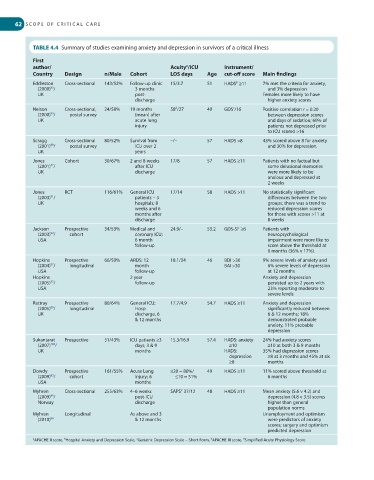
            TABLE 4.4  Summary of studies examining anxiety and depression in survivors of a critical illness

            First
                                                              a
            author/                                      Acuity /ICU      Instrument/
            Country   Design       n/Male   Cohort       LOS days    Age  cut-off score  Main findings
                                                                              b
            Eddleston   Cross-sectional  143/52%  Follow-up clinic   15/3.7  51  HADS  ≥11  7% met the criteria for anxiety,
             (2000) /                        3 months                                    and 3% depression
                  83
             UK                              post-                                     Females more likely to have
                                             discharge                                   higher anxiety scores
                                                                             c
            Nelson    Cross-sectional,   24/58%  19 months   58 /27  40   GDS /16      Positive correlation r = 0.30
                                                          d
             (2000) /   postal survey        (mean) after                                between depression scores
                  90
             UK                              acute lung                                  and days of sedation; 69% of
                                             injury                                      patients not depressed prior
                                                                                         to ICU scored >16
            Scragg    Cross-sectional   80/52%  Survival from   –/–  57   HADS >8      43% scored above 8 for anxiety
             (2001) /   postal survey        ICU over 2                                  and 30% for depression.
                  88
             UK                              years
            Jones     Cohort       30/67%   2 and 8 weeks   17/8     57   HADS ≥11     Patients with no factual but
                  57
             (2001) /                        after ICU                                   some delusional memories
             UK                              discharge                                   were more likely to be
                                                                                         anxious and depressed at
                                                                                         2 weeks
            Jones     RCT          116/61%  General ICU   17/14      58   HADS >11     No statistically significant
                  91
             (2003) /                        patients – 3                                differences between the two
             UK                              hospitals; 8                                groups; there was a trend to
                                             weeks and 6                                 reduced depression scores
                                             months after                                for those with scores >11 at
                                             discharge                                   8 weeks
            Jackson   Prospective   34/53%  Medical and   24.9/–     53.2  GDS-SF ≥6   Patients with
                  92
             (2003) /   cohort               coronary ICU;                               neuropsychological
             USA                             6 month                                     impairment were more like to
                                             follow-up                                   score above the threshold at
                                                                                         6 months (36% v 17%).
            Hopkins   Prospective   66/50%  ARDS; 12     18.1/34     46   BDI >30      9% severe levels of anxiety and
                  87
             (2004) /   longitudinal         month                        BAI >30        6% severe levels of depression
             USA                             follow-up                                   at 12 months
            Hopkins                         2 year                                     Anxiety and depression
             (2005) /                        follow-up                                   persisted up to 2 years with
                  93
             USA                                                                         23% reporting moderate to
                                                                                         severe levels
            Rattray   Prospective   80/64%  General ICU;   17.7/4.9  54.7  HADS ≥11    Anxiety and depression
                  85
             (2005) /   longitudinal         Hosp                                        significantly reduced between
             UK                              discharge, 6                                6 & 12 months; 18%
                                             & 12 months                                 demonstrated probable
                                                                                         anxiety, 11% probable
                                                                                         depression
            Sukantarat   Prospective  51/43%  ICU patients ≥3   15.3/16.9  57.4  HADS: anxiety   24% had anxiety scores
                  184
             (2007) /                        days; 3 & 9                    ≥10          ≥10 at both 3 & 9 months
             UK                              months                       HADS:        35% had depression scores
                                                                            depression   ≥8 at 3 months and 45% at six
                                                                            ≥8           months
            Dowdy     Prospective   161/55%  Acute Lung   ≤20 = 80%/  49  HADS ≥11     11% scored above threshold at
             (2009) /   cohort               Injury; 6    ≤10 = 51%                      6 months
                  82
             USA                             months
            Myhren    Cross-sectional  255/63%  4–6 weeks   SAPS  37/12  48  HADS ≥11  Mean anxiety (5.6 v 4.2) and
                                                            e
                  84
             (2009) /                        post-ICU                                    depression (4.8 v 3.5) scores
             Norway                          discharge                                   higher than general
                                                                                         population norms
            Myhren    Longitudinal          As above and 3                             Unemployment and optimism
             (2010) 86                       & 12 months                                 were predictors of anxiety
                                                                                         scores; surgery and optimism
                                                                                         predicted depression
            a APACHE II score,  Hospital Anxiety and Depression Scale,  Geriatric Depression Scale – Short Form,  APACHE III score,  Simplified Acute Physiology Score
                                                                                 e
                      b
                                                                      d
                                              c

