


Page 83 - ACCCN's Critical Care Nursing
P. 83
60  S C O P E   O F   C R I T I C A L   C A R E

         most  commonly  used  and  validated  instrument  in  the   Physical  activity  associated  with  cardiac  or  pulmonary
         literature, including with a variety of critically ill patient   dysfunction may be assessed using perceived breathless-
         groups (e.g. general ICU, ARDS, trauma and septic shock).   ness  (dyspnoea)  during  exercise  by  the  modified  Borg
                                                                   50
         A recent comparison of two related instruments demon-  scale,  ranging from 0 (no dyspnoea) to 10+ (maximal).
         strated  that  the  15D  was  more  sensitive  to  clinically   The  Borg  scale  is  commonly  used  with  other  physical
         important differences in health status than EQ-5D in a   activity  instruments,  e.g.  the  six-minute  walk  test
         critical care cohort. 46                             (6MWT). 51
         MEASURES OF PHYSICAL FUNCTION                        MEASURES OF PSYCHOLOGICAL FUNCTION
         FOLLOWING A CRITICAL ILLNESS                         AFTER A CRITICAL ILLNESS
         A variety of instruments have been developed to examine   The recovery process and trajectory for survivors of a criti-
         the physical capacity of individuals, usually focusing on   cal  illness  remains  an  important  but  under-researched
         functional  status  ranging  from  independent  to  depen-  area. 18,52  Exploration of the impact of the intensive care
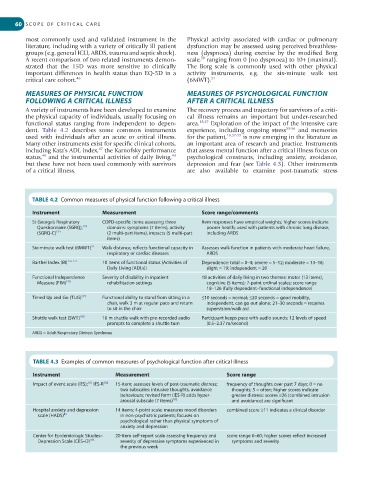
         dent.  Table  4.2  describes  some  common  instruments   experience,  including  ongoing  stress 53-56   and  memories
         used  with  individuals  after  an  acute  or  critical  illness.   for the patient, 16,57-59  is now emerging in the literature as
         Many other instruments exist for specific clinical cohorts,   an important area of research and practice. Instruments
                                 47
         including Katz’s ADL index,  the Karnofsky performance   that assess mental function after a critical illness focus on
               48
                                                         49
         status,  and the instrumental activities of daily living,    psychological  constructs,  including  anxiety,  avoidance,
         but these have not been used commonly with survivors   depression  and  fear  (see  Table  4.3).  Other  instruments
         of a critical illness.                               are  also  available  to  examine  post-traumatic  stress


            TABLE 4.2  Common measures of physical function following a critical illness

            Instrument            Measurement                      Score range/comments
            St George’s Respiratory   COPD-specific items assessing three   Item responses have empirical weights; higher scores indicate
                            173
             Questionnaire (SGRQ),    domains: symptoms (7 items), activity    poorer health; used with patients with chronic lung disease,
             (SGRQ-C) 174           (2 multi-part items), impacts (5 multi-part   including ARDS
                                    items)
            Six-minute walk test (6MWT) 51  Walk distance, reflects functional capacity in   Assesses walk function in patients with moderate heart failure,
                                    respiratory or cardiac diseases  ARDS
            Barthel Index (BI) 175-177  10 items of functional status (Activities of   Dependence: total = 0–4; severe = 5–12; moderate = 13–18;
                                    Daily Living [ADLs])             slight = 19; independent = 20
            Functional Independence   Severity of disability in inpatient   18 activities of daily living in two themes: motor (13 items),
             Measure (FIM) 178      rehabilitation settings          cognitive (5 items); 7-point ordinal scales; score range
                                                                     18–126 (fully dependent–functional independence)
            Timed Up and Go (TUG) 179  Functional ability to stand from sitting in a   ≤10 seconds = normal; ≤20 seconds = good mobility,
                                    chair, walk 3 m at regular pace and return   independent, can go out alone; 21–30 seconds = requires
                                    to sit in the chair              supervision/walk aid
            Shuttle walk test (SWT) 180  10 m shuttle walk with pre-recorded audio   Participant keeps pace with audio sounds; 12 levels of speed
                                    prompts to complete a shuttle turn  (0.5–2.37 m/second)
            ARDS = Adult Respiratory Distress Syndrome


            TABLE 4.3  Examples of common measures of psychological function after critical illness

            Instrument                 Measurement                         Score range
            Impact of event scale (IES);  IES-R 182  15-item; assesses levels of post-traumatic distress;   frequency of thoughts over past 7 days; 0 = no
                              181
                                        two subscales: intrusive thoughts, avoidance   thoughts; 5 = often; higher scores indicate
                                        behaviours; revised form (IES-R) adds hyper-  greater distress: scores ≥26 (combined intrusion
                                        arousal subscale (7 items) 182       and avoidance) are significant
            Hospital anxiety and depression   14 items; 4-point scale; measures mood disorders   combined score ≥11 indicates a clinical disorder
             scale (HADS) 89            in non-psychiatric patients; focuses on
                                        psychological rather than physical symptoms of
                                        anxiety and depression
            Center for Epidemiologic Studies–  20-item self-report scale assessing frequency and   score range 0–60; higher scores reflect increased
             Depression Scale (CES–D) 183  severity of depressive symptoms experienced in   symptoms and severity
                                        the previous week

