


Page 55 - E BOOK ENGINE MECHANICAL M2
P. 55
3. FUEL SYSTEM


            1. GENERAL
            A common rail fuel injection system is developed in order to comply with current increasingly-strict
            exhaust gas regulations, and it is completely different from the fuel system equipped with a conven-
            tional injection pump. A common rail fuel injection system is composed of parts including a supply
            pump, common rail, injectors, sensors which convert the engine operating conditions to electrical
            signals, and an Engine-ECU which controls these components.
            The followings are the components related to the common rail fuel supply system:
            ◆  Fuel injector assembly (to be explained in the section: Common rail fuel system)
            ◆  Supply pump assembly
            ◆  Common rail assembly
            ◆  Fuel tank assembly
            ◆  Fuel filter assembly


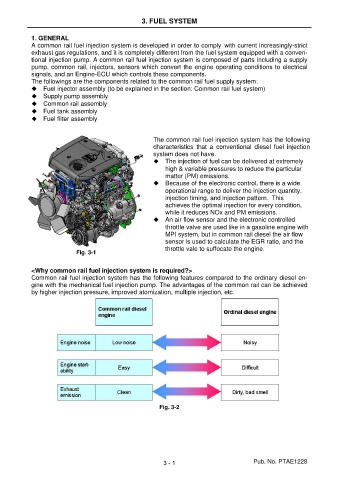
                                                       The common rail fuel injection system has the following
                                                       characteristics  that  a  conventional  diesel  fuel  injection
                                                       system does not have.
                                                       ◆  The injection of fuel can be delivered at extremely
                                                           high & variable pressures to reduce the particular
                                                           matter (PM) emissions.
                                                       ◆  Because of the electronic control, there is a wide
                                                           operational range to deliver the injection quantity,
                                                           injection timing, and injection pattern.  This
                                                           achieves the optimal injection for every condition,
                                                           while it reduces NOx and PM emissions.
                                                       ◆  An air flow sensor and the electronic controlled
                                                           throttle valve are used like in a gasoline engine with
                                                           MPI system, but in common rail diesel the air flow
                                                           sensor is used to calculate the EGR ratio, and the
                            Fig. 3-1                       throttle vale to suffocate the engine.


            <Why common rail fuel injection system is required?>
            Common rail fuel injection system has the following features compared to the ordinary diesel en-
            gine with the mechanical fuel injection pump. The advantages of the common rail can be achieved
            by higher injection pressure, improved atomization, multiple injection, etc.


                                                         Fig. 3-2


                                                          3 - 1                           Pub. No. PTAE1228

