


Page 50 - E BOOK ENGINE MECHANICAL M2
P. 50
1. GENERAL


           7. DIESEL FUEL
           Diesel fuel looks like kerosene, but it is slightly yellowish and is somewhat cloudier and more viscous
           than kerosene. The specific gravity of the diesel fuel is 0.82 to 0.87 and its required properties are as
           follows.
           ◇  Good ignitability
           ◇  Proper viscosity
           ◇  Least water and impurities
           ◇  Least sulfur content
           ◇  Volatility and other properties

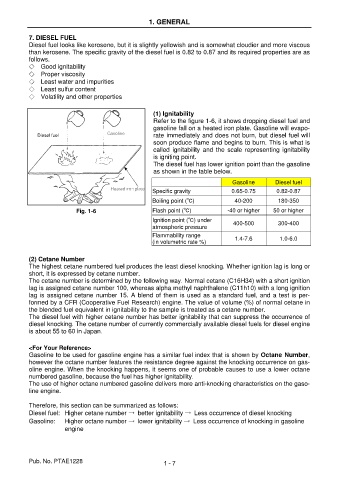
                                                       (1) Ignitability
                                                       Refer to the figure 1-6, it shows dropping diesel fuel and
                                                       gasoline fall on a heated iron plate. Gasoline will evapo-
              Diesel fuel                              rate immediately and does not burn, but diesel fuel will
                                                       soon produce flame and begins to burn. This is what is
                                                       called  ignitability  and  the  scale  representing  ignitability
                                                       is igniting point.
                                                       The diesel fuel has lower ignition point than the gasoline
                                                       as shown in the table below.
                                                                                   Gasoline       Diesel fuel
                                                       Specific gravity           0.65-0.75       0.82-0.87

                                                       Boiling point (℃)           40-200          180-350
                            Fig. 1-6                   Flash point (℃)           -40 or higher   50 or higher
                                                       Ignition point (℃) under
                                                                                   400-500         300-400
                                                       atmospheric pressure
                                                       Flammability range
                                                       (in volumetric rate %)      1.4-7.6         1.0-6.0


           (2) Cetane Number
           The highest cetane numbered fuel produces the least diesel knocking. Whether ignition lag is long or
           short, it is expressed by cetane number.
           The cetane number is determined by the following way. Normal cetane (C16H34) with a short ignition
           lag is assigned cetane number 100, whereas alpha methyl naphthalene (C11h10) with a long ignition
           lag is assigned cetane number 15. A blend of them is used as a standard fuel, and a test is per-
           formed by a CFR (Cooperative Fuel Research) engine. The value of volume (%) of normal cetane in
           the blended fuel equivalent in ignitability to the sample is treated as a cetane number.
           The diesel fuel with higher cetane number has better ignitability that can suppress the occurrence of
           diesel knocking. The cetane number of currently commercially available diesel fuels for diesel engine
           is about 55 to 60 in Japan.


           <For Your Reference>
           Gasoline to be used for gasoline engine has a similar fuel index that is shown by Octane Number,
           however the octane number features the resistance degree against the knocking occurrence on gas-
           oline engine. When the knocking happens, it seems one of probable causes to use a lower octane
           numbered gasoline, because the fuel has higher ignitability.
           The use of higher octane numbered gasoline delivers more anti-knocking characteristics on the gaso-
           line engine.

           Therefore, this section can be summarized as follows:
           Diesel fuel:  Higher cetane number → better ignitability → Less occurrence of diesel knocking
           Gasoline:    Higher octane number → lower ignitability → Less occurrence of knocking in gasoline
                        engine


           Pub. No. PTAE1228
                                                          1 - 7

