


Page 8 - E BOOK ENGINE MECHANICAL M2
P. 8
1. TECHNICAL FEATURES OF 4B1 ENGINE


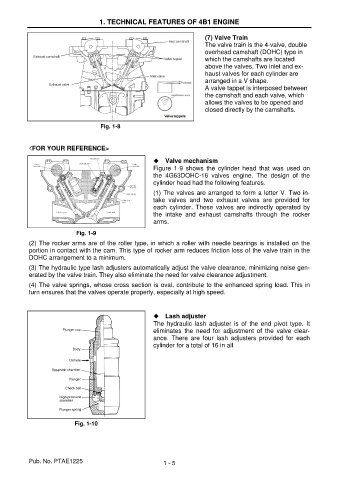
                                                                         (7) Valve Train
                                                                         The valve train is the 4-valve, double
                                                                         overhead camshaft (DOHC) type in
                                                                         which the camshafts are located
                                                                         above the valves. Two inlet and ex-
                                                                         haust valves for each cylinder are
                                                                         arranged in a V shape.
                                                                         A valve tappet is interposed between
                                                                         the camshaft and each valve, which
                                                                         allows the valves to be opened and
                                                                         closed directly by the camshafts.

                                    Fig. 1-8


           < << <FOR YOUR REFERENCE>

                                                       ◆  Valve mechanism
                                                       Figure  1-9  shows  the  cylinder  head  that  was  used  on
                                                       the  4G63DOHC-16  valves  engine.  The  design  of  the
                                                       cylinder head had the following features.
                                                       (1) The valves are arranged to form a letter V. Two in-
                                                       take  valves  and  two  exhaust  valves  are  provided  for
                                                       each  cylinder.  These  valves  are  indirectly  operated  by
                                                       the  intake  and  exhaust  camshafts  through  the  rocker
                                                       arms.
                            Fig. 1-9

           (2) The rocker arms are of the roller type, in which a roller with needle bearings is installed on the
           portion in contact with the cam. This type of rocker arm reduces friction loss of the valve train in the
           DOHC arrangement to a minimum.
           (3) The hydraulic type lash adjusters automatically adjust the valve clearance, minimizing noise gen-
           erated by the valve train. They also eliminate the need for valve clearance adjustment.
           (4) The valve springs, whose cross section is oval, contribute to the enhanced spring load. This in
           turn ensures that the valves operate properly, especially at high speed.


                                                       ◆  Lash adjuster
                                                       The  hydraulic  lash  adjuster  is  of  the  end  pivot  type.  It
                                                       eliminates  the  need  for  adjustment  of  the  valve  clear-
                                                       ance.  There  are  four  lash  adjusters  provided  for  each
                                                       cylinder for a total of 16 in all.


                           Fig. 1-10


           Pub. No. PTAE1225                              1 - 5

