


Page 121 - Concise Pathology for Exam Preparation ( PDFDrive )
P. 121
106   SECTION I    General Pathology


                        (b)
                            Peripheral suppression by T cells
                              •	�A population of T cells is called ‘regulatory T cells’. These cells have the ability
                             to down regulate function of autoreactive T cells. This is mediated by secretion
                             of cytokines.

                              •	�CD41 T cells of T H 2 type are the best known ‘regulatory cells’ and are thought
                             to mediate their action via cytokines like IL4, IL10 and TGF b.
                            Clonal deletion by activation-induced cell death
                        (c)
                              •	�CD41 T cells that recognize self-antigens may receive signals that promote their

                             death by apoptosis.
                              •	�Lymphocytes express Fas (CD95), a member of TNF receptor family.
                              •	�Fas ligand (Fas L) is a member protein that is structurally homologous to the
                             cytokine TNF, and is expressed mainly on activated T lymphocytes.
                              •	�Engagement of Fas by Fas L induces apoptosis of activated T cells and may cause
                             peripheral deletion of autoreactive T cells.
                              •	�Self-reactive B cells are also deleted by Fas L on T cells due to engaging of Fas
                             on B cells.
                            Antigen sequestration
                        (d)
                        Some antigens are hidden from the immune system because the tissues in which these
                     antigens are located do not communicate with the blood and lymph, eg, testis, eye and
                     brain.

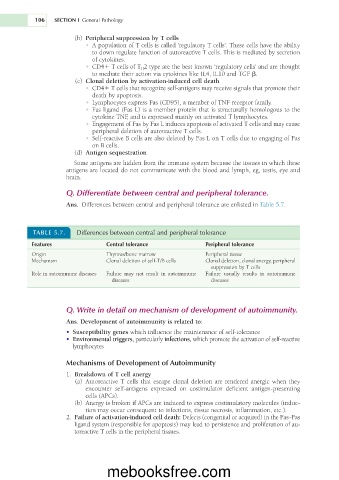
                     Q.   Differentiate between central and peripheral tolerance.

                     Ans.    Differences between central and peripheral tolerance are enlisted in Table 5.7.


           TABLE   5.7.   Differences between central and peripheral tolerance
           Features               Central tolerance	�           Peripheral tolerance
           Origin                 Thymus/bone marrow            Peripheral tissue
           Mechanism              Clonal deletion of self-T/B cells   Clonal deletion, clonal anergy, peripheral
                                                                  suppression by T cells
           Role in autoimmune diseases   Failure  may  not  result  in  autoimmune   Failure  usually  results  in  autoimmune
                                   diseases                       diseases


                     Q.   Write in detail on mechanism of development of autoimmunity.
                     Ans. Development of autoimmunity is related to:

                        •	�Susceptibility genes which influence the maintenance of self-tolerance


                        •	�Environmental triggers, particularly infections, which promote the activation of self-reactive
                       lymphocytes
                     Mechanisms of Development of Autoimmunity
                        	�Breakdown of T cell anergy
                     1.
                        (a)
                            Autoreactive T cells that escape clonal deletion are rendered anergic when they
                           encounter  self-antigens  expressed  on  costimulator  deficient  antigen-presenting
                           cells (APCs).
                        (b)
                            Anergy is broken if APCs are induced to express costimulatory molecules (induc-
                           tion may occur consequent to infections, tissue necrosis, inflammation, etc.).
                     2 .
                        	�Failure of activation-induced cell death: Defects (congenital or acquired) in the Fas–Fas


                        ligand   system (responsible for apoptosis) may lead to persistence and proliferation of au-


                        toreactive     T cells in the peripheral tissues.


                                  mebooksfree.com

