


Page 118 - Concise Pathology for Exam Preparation ( PDFDrive )
P. 118
5 Diseases of Immunity 103
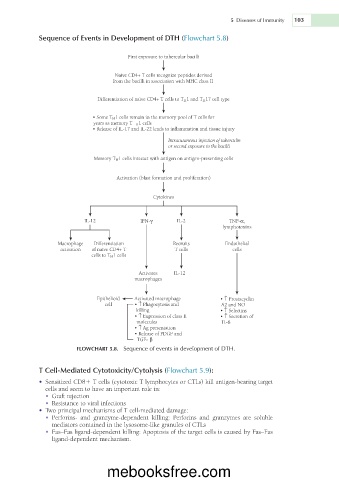
Sequence of Events in Development of DTH (Flowchart 5.8)
First exposure to tubercular bacilli
Naïve CD4+ T cells recognize peptides derived
from the bacilli in association with MHC class II
Differentiation of naïve CD4+ T cells to T H 1 and T H 17 cell type
• Some T H 1 cells remain in the memory pool of T cells for
years as memory T H 1 cells
• Release of IL17 and IL22 leads to inflammation and tissue injury
Intracutaneous injection of tuberculin
or second exposure to the bacilli
Memory T H 1 cells interact with antigen on antigenpresenting cells
Activation (blast formation and proliferation)
Cytokines
IL12 IFNγ IL2 TNFα,
lymphotoxins
Macrophage Differentiation Recruits Endothelial
activation of naïve CD4+ T T cells cells
cells to T H 1 cells
Activates IL12
macrophages
Epithelioid Activated macrophage • ↑ Prostacyclin
cell • ↑ Phagocytosis and A2 and NO
killing • ↑ Selectins
• ↑ Expression of class II • ↑ Secretion of
molecules IL8
• ↑ Ag presentation
• Release of PDGF and
TGF β
FLOWCHART 5.8. Sequence of events in development of DTH.
T Cell-Mediated Cytotoxicity/Cytolysis (Flowchart 5.9):
• �Sensitized CD81 T cells (cytotoxic T lymphocytes or CTLs) kill antigen-bearing target
cells and seem to have an important role in:
• Graft rejection
• Resistance to viral infections
• Two principal mechanisms of T cell-mediated damage:
• �Perforins- and granzyme-dependent killing: Perforins and granzymes are soluble
mediators contained in the lysosome-like granules of CTLs
• �Fas–Fas ligand-dependent killing: Apoptosis of the target cells is caused by Fas–Fas
ligand-dependent mechanism.
mebooksfree.com

