


Page 122 - Concise Pathology for Exam Preparation ( PDFDrive )
P. 122
5  Diseases of Immunity   107


                	�Failure of T cell-mediated suppression: Loss of regulatory/suppressor T cells that can
             3.
                limit the function of autoreactive T and B cells.
                	�Molecular mimicry
             4.
                    Some infective agents share epitopes with self-antigens.
                (a)
                    Immune  response  against  such  microbes  produces  a  tissue  damaging  reaction,
                (b)
                   eg,  rheumatic  heart  disease:  cross-reaction  between  antibodies  to  streptococcal
                   M protein and cardiac glycoproteins.
             5.
                	�Polyclonal lymphocyte activation


                 )
                (
                a

                    Several  microorganisms  and  their  products  (eg,  bacterial  lipopolysaccharides


                                                               B


                   or   endotoxins) are capable     inducing polyclonal     cell activation or CD41

                                            f
                                           o


                      T cells activation in an antigen-independent manner. Because they stimulate all


                      T cells that are associated with a set of V TCRS, they are called super antigens


                   (SAgs).

                (b)
                    They do so by binding to MHC class II on APC and b chains on TCR outside the
                   antigen-binding groove.

                c
                (


                   )  This causes a massive immune response that is not specific to any particular epitope


                   on   the SAg.

                (d)
                    Among T cells activated by super antigens, some may be reactive to self-antigens
                   leading to autoimmunity.
                    SAgs produce an immune response that is effectively useless. Microbes produce
                (e)
                   SAgs as a defence mechanism to aid them in evading the immune system.
                	�Release of sequestered antigens (anatomic sequestration): Any self-antigen that is
             6.
                completely sequestered during development is likely to be viewed as foreign when intro-
                duced in the circulation, eg, spermatozoa {post-traumatic orchitis) and ocular antigens
                (uveitis).
             7 .
                	�Exposure of cryptic self-antigens and epitope spreading (molecular sequestra-


                     A

                                   o
                                    f


                tion):     large number     self-determinants are not readily recognized by the im-


                mune    system,  and  hence,      cells  specific  for  such  ‘cryptic’  self-epitopes  are  not


                                      T


                deleted.
             Evidence Implicating Genetic Factors in Development of
             Autoimmunity
                •	�Familial clustering
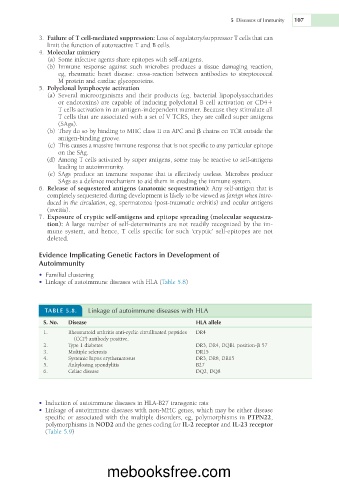
                •	�Linkage of autoimmune diseases with HLA (Table 5.8)
               TABLE   5.8.   Linkage of autoimmune diseases with HLA
              S. No.   Disease	�                             HLA allele
              1.	�    Rheumatoid arthritis anti-cyclic citrullinated peptides   DR4
                        (CCP) antibody positive.
              2.      Type 1 diabetes	�                      DR3, DR4, DQB1 position-b  57

              3.      Multiple sclerosis	�                   DR15
              4.      Systemic lupus erythematosus	�         DR3, DR8, DR15
              5.      Ankylosing spondylitis	�               B27
              6.      Celiac disease	�                       DQ2, DQ8
                •	�Induction of autoimmune diseases in HLA-B27 transgenic rats


                •	�Linkage of autoimmune diseases with non-MHC genes, which may be either disease


               specific   or  associated  with  the  multiple  disorders,  eg,  polymorphisms      PTPN22,

                                                                           n
                                                                           i


                            i

               polymorphisms     NOD2 and the genes coding for IL-2 receptor and IL-23 receptor


                             n


               (Table   5.9)
                                  mebooksfree.com

