


Page 150 - Concise Pathology for Exam Preparation ( PDFDrive )
P. 150
6  Neoplasia  135


                                   External signals (growth factors, integrins)

                                    Activation of MYC, RAS and other genes


                                          Synthesis of cyclin D

                                    Cyclin D + CDK4 form an active complex
                                                             P16, INK4, P21
                                  RB phosphorylation in E2F/DP1/RB complex
                (in its hypophosphorylated form, RB binds to and sequesters a transcription activator called E2F; RB is
                          removed from E2F by phosphorylation and free E2F is made available)

                                              Free E2F

                                          Cyclin E transcription

                                              Cyclin E


                                      Cyclin E/CDK 2 (active complex)
                                                      P27
                                            G1       S
                Note: The cell cycle is blocked by P21, P27, P16 and INK4.
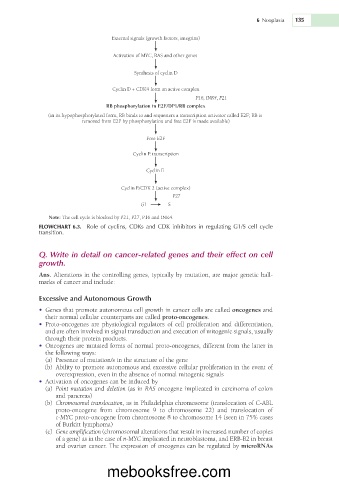
             FLOWCHART 6.3.  Role of cyclins, CDKs and CDK inhibitors in regulating G1/S cell cycle
             transition.


             Q. Write in detail on cancer-related genes and their effect on cell
             growth.
             Ans. Alterations in the controlling genes, typically by mutation, are major genetic hall-
             marks of cancer and include:
             Excessive and Autonomous Growth

             •  Genes that promote autonomous cell growth in cancer cells are called oncogenes and
               their normal cellular counterparts are called proto-oncogenes.
             •  Proto-oncogenes  are  physiological  regulators  of  cell  proliferation  and  differentiation,
               and are often involved in signal transduction and execution of mitogenic signals, usually
               through their protein products.
             •  Oncogenes are mutated forms of normal proto-oncogenes, different from the latter in
               the following ways:
               (a)  Presence of mutation/s in the structure of the gene
               (b)  Ability to promote autonomous and excessive cellular proliferation in the event of
                  overexpression, even in the absence of normal mitogenic signals
             •  Activation of oncogenes can be induced by
               (a)  Point mutation and deletion (as in RAS oncogene implicated in carcinoma of colon
                  and pancreas)
               (b)  Chromosomal translocation, as in Philadelphia chromosome (translocation of C-ABL
                  proto-oncogene  from  chromosome  9  to  chromosome  22)  and  translocation  of
                  c-MYC proto-oncogene from chromosome 8 to chromosome 14 (seen in 75% cases
                  of Burkitt lymphoma)
               (c)  Gene amplification (chromosomal alterations that result in increased number of copies
                  of a gene) as in the case of n-MYC implicated in neuroblastoma, and ERB-B2 in breast
                  and ovarian cancer. The expression of oncogenes can be regulated by microRNAs


                                  mebooksfree.com

