


Page 152 - Concise Pathology for Exam Preparation ( PDFDrive )
P. 152
6  Neoplasia  137


                    Kirsten and NRAS was named so as it was initially identified in neuroblastoma
                    cells) are the most common form of abnormality affecting a proto-oncogene in
                    human tumours. As a member of the family of small G proteins, it is mainly im-
                    plicated in the pathogenesis of carcinoma of colon, lungs and pancreas.
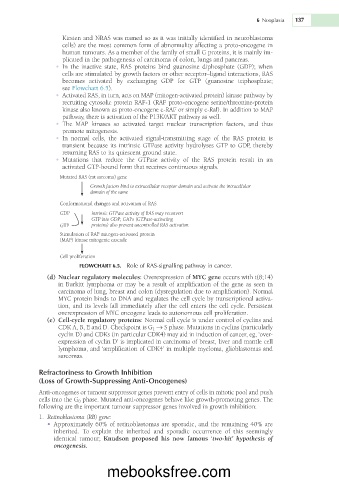
                  •  In  the  inactive  state,  RAS  proteins  bind  guanosine  diphosphate  (GDP);  when
                    cells are stimulated by growth factors or other receptor–ligand interactions, RAS
                    becomes  activated  by  exchanging  GDP  for  GTP  (guanosine  triphosphate;
                    see Flowchart 6.5).
                  •  Activated RAS, in turn, acts on MAP (mitogen-activated protein) kinase pathway by
                    recruiting cytosolic protein RAF-1 (RAF proto-oncogene serine/threonine-protein
                    kinase also known as proto-oncogene c-RAF or simply c-Raf). In addition to MAP
                    pathway, there is activation of the P13K/AKT pathway as well.
                  •  The  MAP  kinases  so  activated  target  nuclear  transcription  factors,  and  thus
                    promote mitogenesis.
                  •  In  normal  cells,  the  activated  signal-transmitting  stage  of  the  RAS  protein  is
                    transient because its intrinsic GTPase activity hydrolyses GTP to GDP, thereby
                    returning RAS to its quiescent ground state.
                  •  Mutations  that  reduce  the  GTPase  activity  of  the  RAS  protein  result  in  an
                    activated GTP-bound form that receives continuous signals.

                   Mutated RAS (rat sarcoma) gene
                             Growth factors bind to extracellular receptor domain and activate the intracellular
                             domain of the same

                   Conformational changes and activation of RAS
                   GDP       Intrinsic GTPase activity of RAS may reconvert
                             GTP into GDP; GAPs (GTPase-activating
                   GTP       proteins) also prevent uncontrolled RAS activation
                   Stimulation of RAF mitogen-activated protein
                   (MAP) kinase mitogenic cascade

                   Cell proliferation
                         FLOWCHART 6.5.  Role of RAS-signalling pathway in cancer.

                  (d) Nuclear regulatory molecules: Overexpression of MYC gene occurs with t(8;14)
                   in Burkitt lymphoma or may be a result of amplification of the gene as seen in
                   carcinoma of lung, breast and colon (dysregulation due to amplification). Normal
                   MYC protein binds to DNA and regulates the cell cycle by transcriptional activa-
                   tion, and its levels fall immediately after the cell enters the cell cycle. Persistent
                   overexpression of MYC oncogene leads to autonomous cell proliferation.
                  (e)  Cell-cycle regulatory proteins: Normal cell cycle is under control of cyclins and
                   CDK A, B, E and D. Checkpoint is G 1  → S phase. Mutations in cyclins (particularly
                   cyclin D) and CDKs (in particular CDK4) may aid in induction of cancer, eg, ‘over-
                   expression of cyclin D’ is implicated in carcinoma of breast, liver and mantle cell
                   lymphoma, and ‘amplification of CDK4’ in multiple myeloma, glioblastomas and
                   sarcomas.

             Refractoriness to Growth Inhibition
             (Loss of Growth-Suppressing Anti-Oncogenes)

             Anti-oncogenes or tumour suppressor genes prevent entry of cells in mitotic pool and push
             cells into the G 0  phase. Mutated anti-oncogenes behave like growth-promoting genes. The
             following are the important tumour suppressor genes involved in growth inhibition:
               1.  Retinoblastoma (RB) gene:
                •  Approximately 60% of retinoblastomas are sporadic, and the remaining 40% are
                  inherited.  To  explain  the  inherited  and  sporadic  occurrence  of  this  seemingly
                  identical  tumour,  Knudson  proposed  his  now  famous  ‘two-hit’  hypothesis  of
                  oncogenesis.


                                  mebooksfree.com

