


Page 151 - Concise Pathology for Exam Preparation ( PDFDrive )
P. 151
136   SECTION I  General Pathology


                           (miRNAs)—small RNAs 21–25 nucleotides in length that control gene expression by
                           downregulating them. Mutations in such miRNAs (known as oncomirs) can lead to
                           the activation of oncogenes.
                     •  Oncoproteins are products of oncogenes, which resemble products of proto-oncogenes,
                       but are devoid of important regulatory mechanisms. They include:
                       (a)  Growth factors (GFs):
                           •  These are polypeptides elaborated by many cells that normally act on another
                             cell to stimulate its proliferation (paracrine action), eg, PDGF in glioblastomas,
                             TGF-a in sarcomas and FGF in carcinoma of bowel and breast.
                           •  Many cancer cells are capable of synthesizing the same growth factors that stimulate
                             their growth. An oncogene may cause a cell to secrete growth factors, even though
                             it  does  not  normally  do  so,  thus  inducing  its  own  uncontrolled  proliferation
                             (autocrine loop) and proliferation of neighbouring cells, eg, osteosarcomas encode
                             b-chain of PDGF and the same tumours also express receptors for PDGF.
                           •  A group of related oncogenes that encode homologues of fibroblast growth factors
                             (FGFs), eg, HSTF-1 (heparin-binding secretory transforming factor-1) and INT-2
                             (also known as fibroblast growth factor-3) are activated in several gastrointestinal
                             and breast tumours; b FGF, a member of the fibroblast growth factor family, is ex-
                             pressed in human melanomas but not in normal melanocytes. Hepatocyte growth
                             factor and its receptor c-MET are overexpressed in follicular carcinoma of thyroid.
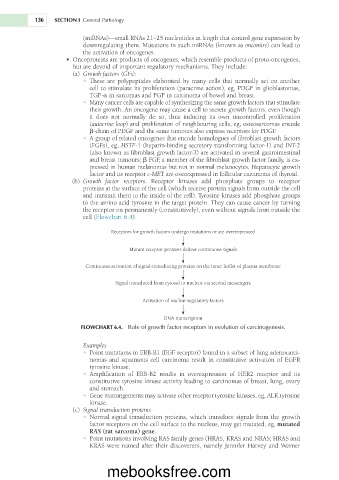
                       (b)  Growth  factor  receptors:  Receptor  kinases  add  phosphate  groups  to  receptor
                           proteins at the surface of the cell (which receive protein signals from outside the cell
                           and transmit them to the inside of the cell). Tyrosine kinases add phosphate groups
                           to the amino acid tyrosine in the target protein. They can cause cancer by turning
                           the receptor on permanently (constitutively), even without signals from outside the
                           cell (Flowchart 6.4).

                                   Receptors for growth factors undergo mutations or are overexpressed

                                         Mutant receptor proteins deliver continuous signals


                           Continuous activation of signal-transducing proteins on the inner leaflet of plasma membrane

                                     Signal transduced from cytosol to nucleus via second messengers

                                             Activation of nuclear regulatory factors


                                                   DNA transcription
                          FLOWCHART 6.4.  Role of growth factor receptors in evolution of carcinogenesis.


                           Examples
                           •  Point mutations in ERB-B1 (EGF receptor) found in a subset of lung adenocarci-
                             nomas and squamous cell carcinoma result in constitutive activation of EGFR
                             tyrosine kinase.
                           •  Amplification  of  ERB-B2  results  in  overexpression  of  HER2  receptor  and  its
                             constitutive tyrosine kinase activity leading to carcinomas of breast, lung, ovary
                             and stomach.
                           •  Gene rearrangements may activate other receptor tyrosine kinases, eg, ALK.tyrosine
                             kinase.
                       (c)  Signal transduction proteins
                           •  Normal signal transduction proteins, which transduce signals from the growth
                             factor receptors on the cell surface to the nucleus, may get mutated, eg, mutated
                             RAS (rat sarcoma) gene.
                           •  Point mutations involving RAS family genes (HRAS, KRAS and NRAS; HRAS and
                             KRAS were named after their discoverers, namely Jennifer Harvey and Werner


                                  mebooksfree.com

