


Page 17 - Concise Pathology for Exam Preparation ( PDFDrive )
P. 17
1


                      Cell Injury and Cell Death


                     Q. Define pathology.

                     Ans. Pathology is the branch  of medical science that deals with  the study of morphologic
                     (structural) changes caused by disease in cells,  tissues, organs, body fluids or whole body
                     (autopsy pathology) . It is derived  from  the words logos (study)  and pathos (suffering).

                     Q.  What  are  the  four  aspects  of a  disease  that  form  the  core  of
                     pathology?
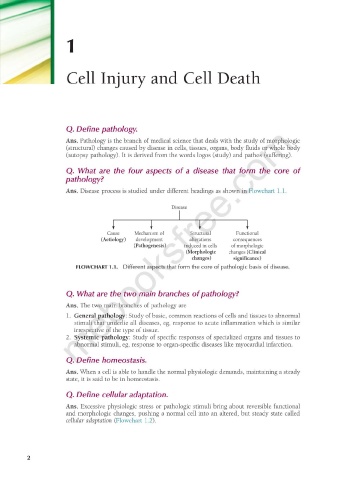
                     Ans.  Disease process is studied under  different headings as shown  in Flowchart 1.1.


                                                      Disease
                                                        I
                                                              i              i
                                  Cause   Mechanism of      Structural    Functional
                                (Aetiology)   development   alterations   consequences
                                          (Pathogenesis)   induced in cells   of morphologic
                                                          (Morphologic   changes (Clinical
                                                            changes)     significance)
                        FLOWCHART 1.1.  Different aspects that form  the core of patho logic basis of disease.


                     Q.  What are the  two main branches of pathology?
                     Ans. The two main branches of pathology are
                     1.  General pathology: Study of basic, common reactions of cells and tissues to abnormal
                        stimuli that  underlie all  diseases, eg,  response  to  acute inflammation  which  is similar
                        irrespective  of the type of tissue.
                     2.  Systemic pathology:  Study of specific  responses  of specialized  organs  and  tissues  to
                        abnormal stimuli, eg, response to organ-specific diseases like myocardial infarction .

                     Q. Define homeostasis.
                     Ans. When  a cell is able to handle the normal physiologic demands, maintaining a steady
                     state, it is said to be in homeostasis.

                     Q. Define cellular adaptation.

                     Ans.  Excessive  physiologic  stress  or  pathologic  stimuli bring about reversible  functional
                     and morphologic  changes,  pushing  a  normal cell  into  an  altered, but steady  state  called
                     cellular adaptation (Flowchart 1.2).


         2

