


Page 18 - Concise Pathology for Exam Preparation ( PDFDrive )
P. 18
1  Cell Injury and Cell Death  3


                                              Cell in homeostasis
                              Excessive physiologic stress  Pathologic stimuli

                                             Cellular adaptation
                                  FLOWCHART 1.2.  Cellular adaptation.


             Q. Define cell injury.
             Ans. When the cell cannot adapt anymore or when the limits of adaptive response to a
             stimulus are exceeded, a sequence of events labelled cell injury follows.
             Q. Enumerate the various cellular responses to injury.

             Ans. Cellular responses to injury may manifest as
               1.  Cellular adaptations: Include atrophy, hypertrophy, hyperplasia and metaplasia.
               2.  Cell  injury:  Sublethal  or  chronic  injurious  stimuli  can  cause  (a)  ‘reversible  and
                irreversible  injury’  (the  latter  may  lead  to  cell  death  by  necrosis  or  apoptosis)  and
                (b) ‘subcellular alterations’ (residual effects of cell injury).
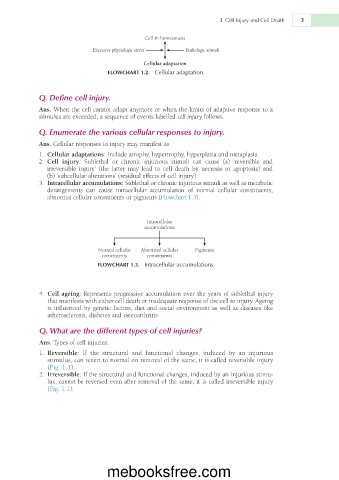
              3.  Intracellular accumulations: Sublethal or chronic injurious stimuli as well as metabolic
                derangements  can  cause  intracellular  accumulation  of  normal  cellular  constituents,
                abnormal cellular constituents or pigments (Flowchart 1.3).


                                              Intracellular
                                             accumulations


                               Normal cellular  Abnormal cellular  Pigments
                                constituents  constituents
                               FLOWCHART 1.3.  Intracellular accumulations.


               4.  Cell ageing: Represents progressive accumulation over the years of sublethal injury
                that manifests with either cell death or inadequate response of the cell to injury. Ageing
                is influenced by genetic factors, diet and social environment as well as diseases like
                atherosclerosis, diabetes and osteoarthritis.

             Q. What are the different types of cell injuries?
             Ans. Types of cell injuries:
               1.  Reversible:  If  the  structural  and  functional  changes,  induced  by  an  injurious
                stimulus, can revert to normal on removal of the same, it is called reversible injury
                (Fig. 1.1).
               2.  Irreversible: If the structural and functional changes, induced by an injurious stimu-
                lus, cannot be reversed even after removal of the same, it is called irreversible injury
                (Fig. 1.1).


                                  mebooksfree.com

