


Page 227 - Concise Pathology for Exam Preparation ( PDFDrive )
P. 227
212    SECTION I  General Pathology


                       2.  Chronic effects: Chronic alcohol intake has deleterious effects on specific organs as
                        described:
                         (a)  Liver: Fatty change, hepatitis, cirrhosis, portal hypertension or hepatocellular car-
                           cinoma are possible effects (alcohol oxidation by ADH causes reduction in nicotin-
                           amide adenine dinucleotide or NAD levels as ADH reduces NAD to NADH. NAD
                           is required for fatty acid oxidation in liver and conversion of lactate into pyruvate.
                           Its deficiency, therefore, causes accumulation of fat in the liver of alcoholics).
                         (b)  Nervous system: Thiamine deficiency is common in alcoholics and is known to
                           induce  degeneration  of  nerve  cells,  reactive  gliosis  and  atrophy  of  cerebellum
                           and peripheral nerves. Two syndromes are closely associated with chronic alcohol
                           intake,  namely,  Wernicke  syndrome,  which  presents  with  ataxia,  disturbed
                           cognition,  ophthalmoplegia,  nystagmus  and  Korsakoff  syndrome,  which  is
                           believed  to  result  from  a  combination  of  alcohol  toxicity,  poor  nutrition  and
                           thiamine deficiency, and manifests with severe memory loss.
                         (c)  CVS: Chronic alcohol intake causes injury to myocardium leading to dilated conges-
                           tive cardiomyopathy, which is thought to be due to direct toxicity rather than thia-
                           mine deficiency. High blood alcohol levels have a vasopressor effect due to release
                           of catecholamines, which may induce hypertension. Heavy consumption of alcohol
                           also leads to decreased levels of high-density lipoproteins (HDL) and contributes
                           to coronary artery disease.
                          (d)  GIT: Alcohol can cause massive bleeding from gastritis/gastric ulcer or oesophageal
                           varices and acute or chronic pancreatitis. It is also associated with increased risk of
                           cancer of the oral cavity, and oesophagus. Ethanol is not a direct-acting carcinogen;
                           but one of its metabolites, acetaldehyde, may act as a tumour promoter. Ethanol
                           inhibits detoxification of chemical carcinogens such as nitrosamines, which have
                           been associated with tumours of the upper gastrointestinal tract.
                         (e)  Reproductive system: Heavy long-term consumption of alcohol is known to cause
                           testicular  atrophy  in  men  and  reduced  fertility  and  spontaneous  abortions  in
                           women.
                         (f)  Skeletal muscle: Alcohol causes rhabdomyolysis, which, in turn, leads to muscle
                           weakness and pain.
                         (g)  Ethanol is a substantial source of energy; therefore, chronic alcoholism commonly
                           leads to malnutrition and deficiencies.
                          (h)  Alcohol  intake  during  pregnancy  can  induce  fetal  alcohol  syndrome,  which
                           manifests in infants as microcephaly, growth retardation and facial abnormalities;
                           older children may show a reduction in mental functions.

                     Smoking
                     Tobacco is the most frequent exogenous cause of human cancer. Main contributor is ciga-
                     rette smoking, but pipes, snuff and tobacco chewing are also harmful. Smoking associated
                     cancers include cancer of the larynx, lung, oesophagus, pancreas, urinary bladder and oral
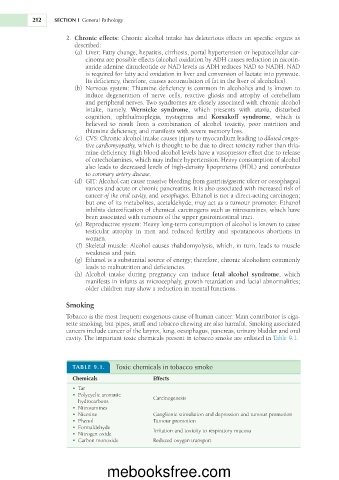
                     cavity. The important toxic chemicals present in tobacco smoke are enlisted in Table 9.1.


                       TABLE 9.1.    Toxic chemicals in tobacco smoke
                       Chemicals                Effects
                       •  Tar
                       •  Polycyclic aromatic   Carcinogenesis
                         hydrocarbons
                       •  Nitrosamines
                       •  Nicotine              Ganglionic stimulation and depression and tumour promotion
                       •  Phenol                Tumour promotion
                       •  Formaldehyde          Irritation and toxicity to respiratory mucosa
                       •  Nitrogen oxide
                       •  Carbon monoxide       Reduced oxygen transport


                                  mebooksfree.com

