


Page 232 - Concise Pathology for Exam Preparation ( PDFDrive )
P. 232
9  Environmental and Nutritional Pathology  217

             Q. Define protein energy malnutrition (PEM).

             Ans.  Inadequate consumption of protein and/or energy resulting in a range of clinical
             syndromes, namely, kwashiorkor and marasmus.

             Q. Differentiate between kwashiorkor and marasmus.

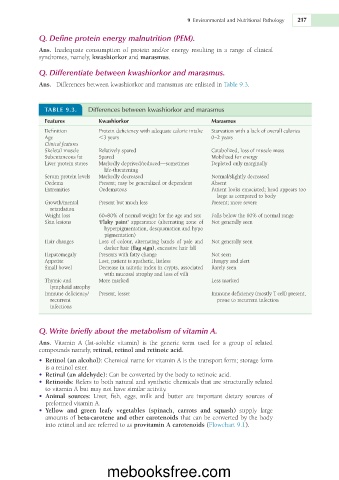
             Ans.   Differences between kwashiorkor and marasmus are enlisted in Table 9.3.


               TABLE 9.3.   Differences between kwashiorkor and marasmus

               Features        Kwashiorkor                        Marasmus
               Definition      Protein deficiency with adequate calorie intake  Starvation with a lack of overall calories
               Age             ,3 years                           0–2 years
               Clinical features
               Skeletal muscle  Relatively spared                 Catabolized, loss of muscle mass
               Subcutaneous fat  Spared                           Mobilized for energy
               Liver protein stores  Markedly deprived/reduced—sometimes    Depleted only marginally
                                 life-threatening
               Serum protein levels  Markedly decreased           Normal/slightly decreased
               Oedema          Present; may be generalized or dependent  Absent
               Extremities     Oedematous                         Patient looks emaciated; head appears too
                                                                    large as compared to body
               Growth/mental    Present but much less             Present; more severe
                 retardation
               Weight loss     60–80% of normal weight for the age and sex  Falls below the 60% of normal range
               Skin lesions    ‘Flaky  paint’  appearance  (alternating  zone  of   Not generally seen
                                 hyperpigmentation, desquamation and hypo
                                 pigmentation)
               Hair changes    Loss  of  colour,  alternating  bands  of  pale  and   Not generally seen
                                 darker hair (flag sign), excessive hair fall
               Hepatomegaly    Presents with fatty change         Not seen
               Appetite        Lost; patient is apathetic, listless  Hungry and alert
               Small bowel     Decrease in mitotic index in crypts, associated   Rarely seen
                                 with mucosal atrophy and loss of villi
               Thymic and      More marked                        Less marked
                 lymphoid atrophy
               Immune deficiency/  Present, lesser                Immune deficiency (mostly T cell) present,
                 recurrent                                          prone to recurrent infection
                 infections


             Q. Write briefly about the metabolism of vitamin A.
             Ans.  Vitamin  A  (fat-soluble  vitamin)  is  the  generic  term  used  for  a  group  of  related
             compounds namely, retinal, retinol and retinoic acid.
             •  Retinol (an alcohol): Chemical name for vitamin A is the transport form; storage form
               is a retinol ester.
             •  Retinal (an aldehyde): Can be converted by the body to retinoic acid.
             •  Retinoids: Refers to both natural and synthetic chemicals that are structurally related
               to vitamin A but may not have similar activity.
             •  Animal  sources:  Liver,  fish,  eggs,  milk  and  butter  are  important  dietary  sources  of
               preformed vitamin A.
             •  Yellow  and  green  leafy  vegetables  (spinach,  carrots  and  squash)  supply  large
               amounts of beta-carotene and other carotenoids that can be converted by the body
               into retinol and are referred to as provitamin A carotenoids (Flowchart 9.1).


                                  mebooksfree.com

