


Page 231 - Concise Pathology for Exam Preparation ( PDFDrive )
P. 231
216    SECTION I  General Pathology


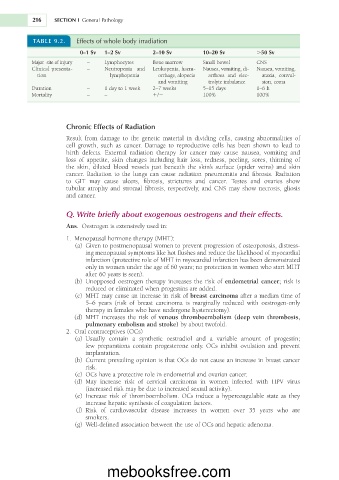
           TABLE 9.2.    Effects of whole body irradiation
                          0–1 Sv  1–2 Sv        2–10 Sv        10–20 Sv         .50 Sv
           Major  site of injury  –  Lymphocytes  Bone marrow  Small bowel      CNS
           Clinical presenta-  –  Neutropenia  and   Leukopenia, haem-  Nausea, vomiting, di-  Nausea, vomiting,
            tion                   lymphopenia    orrhage, alopecia   arrhoea  and  elec-  ataxia,  convul-
                                                  and vomiting   trolyte imbalance  sion, coma
           Duration         –    1 day to 1 week  2–7 weeks    5–15 days        1–6 h
           Mortality        –    –              1/2            100%             100%


                     Chronic Effects of Radiation
                     Result  from  damage  to  the  genetic  material  in  dividing  cells,  causing  abnormalities  of
                     cell  growth,  such  as  cancer.  Damage  to  reproductive  cells  has  been  shown  to  lead  to
                     birth  defects.  External  radiation  therapy  for  cancer  may  cause  nausea,  vomiting  and
                     loss  of  appetite,  skin  changes  including  hair  loss,  redness,  peeling,  sores,  thinning  of
                     the  skin,  dilated  blood  vessels  just  beneath  the  skin’s  surface  (spider  veins)  and  skin
                     cancer. Radiation to the lungs can cause radiation pneumonitis and fibrosis. Radiation
                     to  GIT  may  cause  ulcers,  fibrosis,  strictures  and  cancer.  Testes  and  ovaries  show
                     tubular atrophy and stromal fibrosis, respectively, and CNS may show necrosis, gliosis
                     and cancer.

                     Q. Write briefly about exogenous oestrogens and their effects.

                     Ans.  Oestrogen is extensively used in:
                       1.  Menopausal hormone therapy (MHT):
                        (a)  Given to postmenopausal women to prevent progression of osteoporosis, distress-
                           ing menopausal symptoms like hot flushes and reduce the likelihood of myocardial
                           infarction (protective role of MHT in myocardial infarction has been demonstrated
                           only in women under the age of 60 years; no protection in women who start MHT
                           after 60 years is seen).
                        (b)  Unopposed oestrogen therapy increases the risk of endometrial  cancer;  risk is
                           reduced or eliminated when progestins are added.
                        (c)  MHT may cause an increase in risk of breast carcinoma after a median time of
                           5–6  years  (risk  of  breast  carcinoma  is  marginally  reduced  with  oestrogen-only
                           therapy in females who have undergone hysterectomy).
                        (d)  MHT increases the risk of venous  thromboembolism  (deep  vein  thrombosis,
                           pulmonary embolism and stroke) by about twofold.
                       2.  Oral contraceptives (OCs)
                        (a)  Usually  contain  a  synthetic  oestradiol  and  a  variable  amount  of  progestin;
                           few  preparations  contain  progesterone  only.  OCs  inhibit  ovulation  and  prevent
                           implantation.
                        (b)  Current prevailing opinion is that OCs do not cause an increase in breast cancer
                           risk.
                        (c)  OCs have a protective role in endometrial and ovarian cancer.
                        (d)  May  increase  risk  of  cervical  carcinoma  in  women  infected  with  HPV  virus
                           (increased risk may be due to increased sexual activity).
                        (e)  Increase risk of thromboembolism. OCs induce a hypercoagulable state as they
                           increase hepatic synthesis of coagulation factors.
                        (f)  Risk  of  cardiovascular  disease  increases  in  women  over  35  years  who  are
                           smokers.
                        (g)  Well-defined association between the use of OCs and hepatic adenoma.


                                  mebooksfree.com

