


Page 23 - Concise Pathology for Exam Preparation ( PDFDrive )
P. 23
8     SECTION I  General Pathology


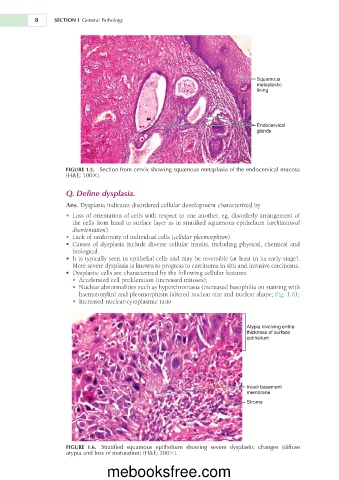
                                                                                Squamous
                                                                                metaplastic
                                                                                lining


                                                                                Endocervical
                                                                                glands


                     FIGURE 1.5.  Section from cervix showing squamous metaplasia of the endocervical mucosa
                     (H&E; 1003).

                     Q. Define dysplasia.

                     Ans. Dysplasia indicates disordered cellular development characterized by
                     •  Loss of orientation of cells with respect to one another, eg, disorderly arrangement of
                       the cells from basal to surface layer as in stratified squamous epithelium (architectural
                       disorientation).
                     •  Lack of uniformity of individual cells (cellular pleomorphism).
                     •  Causes of dysplasia include diverse cellular insults, including physical, chemical and
                       biological.
                     •  It is typically seen in epithelial cells and may be reversible (at least in its early stage).
                       More severe dysplasia is known to progress to carcinoma in situ and invasive carcinoma.
                     •  Dysplastic cells are characterized by the following cellular features:
                       •  Accelerated cell proliferation (increased mitoses);
                       •  Nuclear abnormalities such as hyperchromasia (increased basophilia on staining with
                         haematoxylin) and pleomorphism (altered nuclear size and nuclear shape; Fig. 1.6);
                       •  Increased nuclear-cytoplasmic ratio.


                                                                             Atypia involving entire
                                                                             thickness of surface
                                                                             epithelium


                                                                             Intact basement
                                                                             membrane
                                                                             Stroma


                     FIGURE  1.6.  Stratified  squamous  epithelium  showing  severe  dysplastic  changes  (diffuse
                     atypia and loss of maturation) (H&E; 2003).


                                  mebooksfree.com

