


Page 233 - Concise Pathology for Exam Preparation ( PDFDrive )
P. 233
218    SECTION I  General Pathology


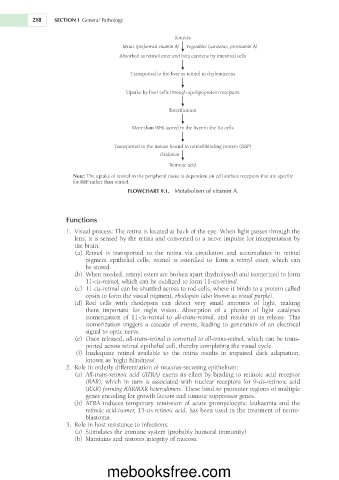
                                                       Sources
                                       Meats (preformed vitamin A)  Vegetables (carotenes, provitamin A)
                                      Absorbed as retinol ester and beta carotene by intestinal cells


                                         Transported to the liver as retinol in chylomicrons

                                        Uptake by liver cells through apolipoprotein receptors


                                                     Esterification

                                          More than 90% stored in the liver in the Ito cells


                                    Transported to the tissues bound to retinol-binding protein (RBP)
                                                  Oxidation
                                                     Retinoic acid
                        Note: The uptake of retinol in the peripheral tissue is dependent on cell surface receptors that are specific
                        for RBP rather than retinol.
                                        FLOWCHART 9.1.  Metabolism of vitamin A.


                     Functions

                       1.  Visual process: The retina is located at back of the eye. When light passes through the
                        lens, it is sensed by the retina and converted to a nerve impulse for interpretation by
                        the brain.
                        (a)  Retinol  is  transported  to  the  retina  via  circulation  and  accumulates  in  retinal
                           pigment  epithelial  cells;  retinol  is  esterified  to  form  a  retinyl  ester,  which  can
                           be stored.
                        (b)  When needed, retinyl esters are broken apart (hydrolysed) and isomerized to form
                           11-cis-retinol, which can be oxidized to form 11-cis-retinal.
                        (c)  11-cis-retinal can be shuttled across to rod cells, where it binds to a protein called
                           opsin to form the visual pigment, rhodopsin (also known as visual purple).
                        (d)  Rod  cells  with  rhodopsin  can  detect  very  small  amounts  of  light,  making
                           them  important  for  night  vision.  Absorption  of  a  photon  of  light  catalyses
                           isomerization  of  11-cis-retinal  to  all-trans-retinal,  and  results  in  its  release.  This
                           isomerization triggers a cascade of events, leading to generation of an electrical
                           signal to optic nerve.
                        (e)  Once released, all-trans-retinal is converted to all-trans-retinol, which can be trans-
                           ported across retinal epithelial cell, thereby completing the visual cycle.
                        (f)  Inadequate  retinol  available  to  the  retina  results  in  impaired  dark  adaptation,
                           known as ‘night blindness’.
                       2.  Role in orderly differentiation of mucous-secreting epithelium:
                        (a)  All-trans-retinoic acid (ATRA) exerts its effect by binding to retinoic acid receptor
                           (RAR), which in turn is associated with nuclear receptors for 9-cis-retinoic acid
                           (RXR) forming RAR/RXR heterodimers. These bind to promoter regions of multiple
                           genes encoding for growth factors and tumour suppressor genes.
                        (b)  ATRA induces temporary remission of acute promyelocytic leukaemia and the
                           retinoic acid isomer, 13-cis retinoic acid, has been used in the treatment of neuro-
                           blastoma.
                       3.  Role in host resistance to infections:
                        (a)  Stimulates the immune system (probably humoral immunity)
                        (b)  Maintains and restores integrity of mucosa


                                  mebooksfree.com

