


Page 234 - Concise Pathology for Exam Preparation ( PDFDrive )
P. 234
9  Environmental and Nutritional Pathology  219

             Q. Enlist the manifestations of vitamin A deficiency.

             Ans.  Manifestations of vitamin A deficiency
             •  First symptom of vitamin A deficiency is decreased night vision (vision in dim light).
             •  Ocular changes due to vitamin A deficiency are collectively known as xerophthalmia (dry eye).
             •  First change is dryness of the conjunctivae, wherein, normal lacrimal and mucous-secreting
               epithelium is replaced by keratinized epithelium.
             •  This is followed by accumulation of keratin debris as small opaque plaques called Bitot
               spots. There is erosion of surface of cornea, inducing formation of corneal ulcers, which
               may later lead to softening and destruction of cornea (keratomalacia) and blindness.
             •  The epithelium lining upper respiratory passage and urinary tract is replaced by keratin-
               ized squamous epithelium (squamous metaplasia).
             •  Loss of mucociliary apparatus predisposes to secondary bacterial infections.
             •  Desquamation  of  keratinous  debris  in  the  urinary  tract  leads  to  renal  and  urinary
               bladder stones.
             •  Hyperplasia and hyperkeratinization of epidermis results in plugging of ducts of adnexal
               glands producing follicular or papular dermatosis.

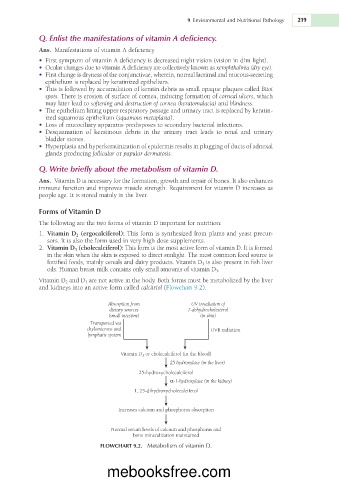
             Q. Write briefly about the metabolism of vitamin D.
             Ans.  Vitamin D is necessary for the formation, growth and repair of bones. It also enhances
             immune function and improves muscle strength. Requirement for vitamin D increases as
             people age. It is stored mainly in the liver.

             Forms of Vitamin D
             The following are the two forms of vitamin D important for nutrition:
               1.  Vitamin D 2  (ergocalciferol): This form is synthesized from plants and yeast precur-
                sors. It is also the form used in very high dose supplements.
              2.  Vitamin D 3  (cholecalciferol): This form is the most active form of vitamin D. It is formed
                in the skin when the skin is exposed to direct sunlight. The most common food source is
                fortified foods, mainly cereals and dairy products. Vitamin D 3  is also present in fish liver
                oils. Human breast milk contains only small amounts of vitamin D 3 .
             Vitamin D 2  and D 3  are not active in the body. Both forms must be metabolized by the liver
             and kidneys into an active form called calcitriol (Flowchart 9.2).


                                  Absorption from           UV irradiation of
                                   dietary sources         7-dehydrocholesterol
                                  (small intestine)            (in skin)
                             Transported via
                            chylomicrons and                      UVB radiation
                            lymphatic system


                                      Vitamin D 3  or cholecalciferol (in the blood)
                                                     25 hydroxylase (in the liver)
                                            25-hydroxycholecalciferol
                                                     α-1-hydroxylase (in the kidney)
                                          1, 25-dihydroxycholecalciferol


                                     Increases calcium and phosphorus absorption


                                   Normal serum levels of calcium and phosphorus and
                                          bone mineralization maintained
                                FLOWCHART 9.2.  Metabolism of vitamin D.


                                  mebooksfree.com

