


Page 258 - Concise Pathology for Exam Preparation ( PDFDrive )
P. 258
10  Blood Vessels  243

             Q. Describe the pathological features and clinical consequences of
             atherosclerosis.
             Ans.  Early lesions show diffuse intimal thickening. Fatty streaks are the forerunners in the
             evolution of atherosclerotic plaques.
               1.  Fatty streaks and dots
               Salient features:
               •  Start  by  themselves  and  are  harmless,  but  are  considered  earliest  precursors  of
                 atheromas.
               •  Usually  begin  in  the  first  year  of  life,  and  are  present  in  all  children  older  than
                 10 years.
               •  Especially prominent in the aorta and other major arteries and are associated with
                 the known risk factors of atherosclerosis.
               Gross:  Multiple  flat  or  slightly  elevated,  yellow  intimal  spots  less  than  1  mm  in
                 diameter, which coalesce into elongated streaks, 1 cm or longer.
               Microscopy:  Composed  of  lipid-laden  macrophages  (foam  cells)  and  a  few  T
                 lymphocytes.
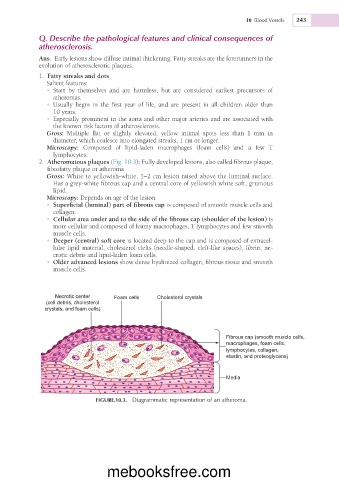
               2.  Atheromatous plaques (Fig. 10.3): Fully developed lesions, also called fibrous plaque,
                fibrofatty plaque or atheroma
               Gross: White to yellowish-white, 1–2 cm lesion raised above the luminal surface.
                 Has a grey-white fibrous cap and a central core of yellowish white soft, grumous
                 lipid.
               Microscopy: Depends on age of the lesion
               •  Superficial (luminal) part of fibrous cap is composed of smooth muscle cells and
                 collagen.
               •  Cellular area under and to the side of the fibrous cap (shoulder of the lesion) is
                 more cellular and composed of foamy macrophages, T lymphocytes and few smooth
                 muscle cells.
               •  Deeper (central) soft core is located deep to the cap and is composed of extracel-
                 lular lipid material, cholesterol clefts (needle-shaped, cleft-like spaces), fibrin, ne-
                 crotic debris and lipid-laden foam cells.
               •  Older advanced lesions show dense hyalinized collagen, fibrous tissue and smooth
                 muscle cells.


                                    Foam cells   Cholesterol crystals
               (cell debris, cholesterol
               crystals, and foam cells)


                                                                       Fibrous cap (smooth muscle cells,
                                                                       macrophages, foam cells,
                                                                       lymphocytes, collagen,
                                                                       elastin, and proteoglycans)


                                                                       Media


                               FIGURE.10.3.  Diagrammatic representation of an atheroma.


                                  mebooksfree.com

