


Page 334 - Concise Pathology for Exam Preparation ( PDFDrive )
P. 334
12  Haematology  319


               2.  Lymphoid leukemoid reactions
               •  Infections like infectious mononucleosis, cytomegalovirus, pertussis, mumps, measles,
                 rubella, tuberculosis, syphilis, brucellosis and infective hepatitis
               •  CLL
               •  Carcinoma

             Q. Differentiate between leukemoid reactions and chromic myeloid
             leukaemia (CML).
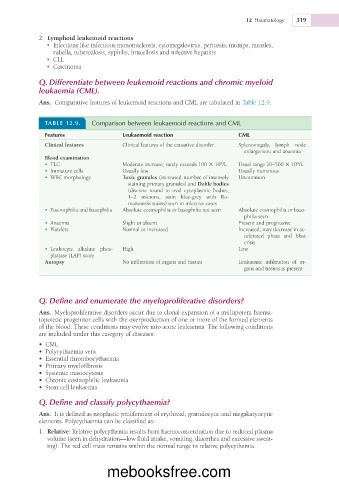
             Ans.  Comparative features of leukemoid reactions and CML are tabulated in Table 12.9.


               TABLE 12.9.   Comparison between leukaemoid reactions and CML
               Features                Leukaemoid reaction                CML
               Clinical features       Clinical features of the causative disorder  Splenomegaly,  lymph  node
                                                                            enlargement and anaemia
               Blood examination
                                                                                            9
                                                                     9
               •  TLC                  Moderate increase; rarely exceeds 100 3 10 /L  Usual range 20–500 3 10 /L
               •  Immature cells       Usually few                        Usually numerous
               •  WBC morphology       Toxic granules (increased number of intensely   Uncommon
                                        staining primary granules) and Dohle bodies
                                        (discrete  round  to  oval  cytoplasmic  bodies,
                                        1–2  microns,  stain  blue-grey  with  Ro-
                                        manowski stains) seen in infective cases
               •  Eosinophilia and basophilia  Absolute eosinophilia or basophilia not seen  Absolute eosinophilia or baso-
                                                                            philia seen
               •  Anaemia              Slight or absent                   Present and progressive
               •  Platelets            Normal or increased                Increased; may decrease in ac-
                                                                            celerated  phase  and  blast
                                                                            crisis
               •  Leukocyte  alkaline  phos-  High                        Low
                 phatase (LAP) score
               Autopsy                 No infiltration of organs and tissues  Leukaemic  infiltration  of  or-
                                                                            gans and tissues is present


             Q. Define and enumerate the myeloproliferative disorders?
             Ans.  Myeloproliferative disorders occur due to clonal expansion of a multipotent haema-
             topoietic progenitor cells with the overproduction of one or more of the formed elements
             of the blood. These conditions may evolve into acute leukaemia. The following conditions
             are included under this category of diseases:
             •  CML
             •  Polycythaemia vera
             •  Essential thrombocythaemia
             •  Primary myelofibrosis
             •  Systemic mastocytosis
             •  Chronic eosinophilic leukaemia
             •  Stem cell leukaemia
             Q. Define and classify polycythaemia?

             Ans.  It is defined as neoplastic proliferation of erythroid, granulocytic and megakaryocytic
             elements. Polycythaemia can be classified as:
              1.  Relative: Relative polycythemia results from haemoconcentration due to reduced plasma
                volume (seen in dehydration—low fluid intake, vomiting, diaorrhea and excessive sweat-
                ing). The red cell mass remains within the normal range in relative polycythemia.


                                  mebooksfree.com

