


Page 336 - Concise Pathology for Exam Preparation ( PDFDrive )
P. 336
12  Haematology  321

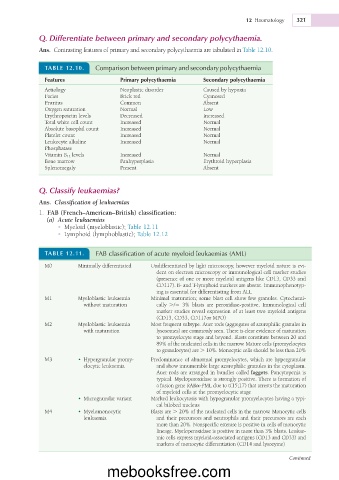
             Q. Differentiate between primary and secondary polycythaemia.

             Ans.  Contrasting features of primary and secondary polycythaemia are tabulated in Table 12.10.

               TABLE 12.10.   Comparison between primary and secondary polycythaemia

               Features               Primary polycythaemia     Secondary polycythaemia
               Aetiology              Neoplastic disorder       Caused by hypoxia
               Facies                 Brick red                 Cyanosed
               Pruritus               Common                    Absent
               Oxygen saturation      Normal                    Low
               Erythropoietin levels  Decreased                 Increased
               Total white cell count  Increased                Normal
               Absolute basophil count  Increased               Normal
               Platelet count         Increased                 Normal
               Leukocyte alkaline     Increased                 Normal
               Phosphatase
               Vitamin B 12  levels   Increased                 Normal
               Bone marrow            Panhyperplasia            Erythroid hyperplasia
               Splenomegaly           Present                   Absent


             Q. Classify leukaemias?
             Ans.  Classification	of	leukaemias
               1.  FAB (French–American–British) classification:
              	 (a)	 Acute	leukaemias
                   •  Myeloid (myeloblastic); Table 12.11
                   •  Lymphoid (lymphoblastic); Table 12.12


               TABLE 12.11.   FAB classification of acute myeloid leukaemias (AML)
               M0        Minimally differentiated  Undifferentiated by light microscopy, however myeloid nature is evi-
                                                 dent on electron microscopy or immunological cell marker studies
                                                 (presence of one or more myeloid antigens like CD13, CD33 and
                                                 CD117). B- and T-lymphoid markers are absent. Immunophenotyp-
                                                 ing is essential for differentiating from ALL
               M1        Myeloblastic leukaemia   Minimal maturation; some blast cell show few granules. Cytochemi-
                           without maturation    cally  ./5  3%  blasts  are  peroxidase-positive.  Immunological  cell
                                                 marker studies reveal expression of at least two myeloid antigens
                                                 (CD13, CD33, CD117or MPO)
               M2        Myeloblastic leukaemia   Most frequent subtype. Auer rods (aggregates of azurophilic granules in
                           with maturation       lysosomes) are commonly seen. There is clear evidence of maturation
                                                 to promyelocyte stage and beyond. Blasts constitute between 20 and
                                                 89% of the nucleated cells in the marrow. Mature cells (promyelocytes
                                                 to granulocytes) are . 10%. Monocytic cells should be less than 20%
               M3        •  Hypergranular promy-  Predominance of abnormal promyelocytes, which are hypergranular
                           elocytic leukaemia    and show innumerable large azurophilic granules in the cytoplasm.
                                                 Auer rods are arranged in bundles called faggots. Pancytopenia is
                                                 typical. Myeloperoxidase is strongly positive. There is formation of
                                                 a fusion gene RARa-PML due to t(15;17) that arrests the maturation
                                                 of myeloid cells at the promyelocytic stage
                         •  Microgranular variant  Marked leukocytosis with hypogranular promyelocytes having a typi-
                                                 cal bilobed nucleus
               M4        •  Myelomonocytic      Blasts are . 20% of the nucleated cells in the marrow. Monocytic cells
                           leukaemia             and their precursors and neutrophils and their precursors are each
                                                 more than 20%. Nonspecific esterase is positive in cells of monocytic
                                                 lineage. Myeloperoxidase is positive in more than 3% blasts. Leukae-
                                                 mic cells express myeloid-associated antigens (CD13 and CD33) and
                                                 markers of monocytic differentiation (CD14 and lysozyme)

                                                                                          Continued
                                  mebooksfree.com

