


Page 342 - Concise Pathology for Exam Preparation ( PDFDrive )
P. 342
12  Haematology  327


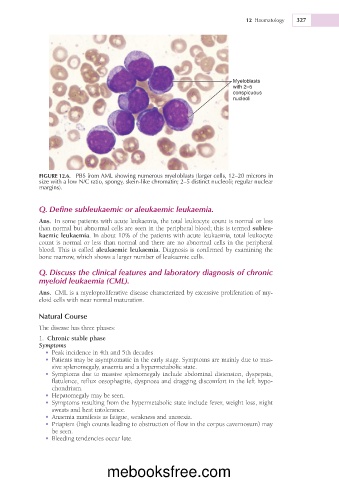
                                                                         Myeloblasts
                                                                         with 2–5
                                                                         conspicuous
                                                                         nucleoli


             FIGURE 12.6.  PBS from AML showing numerous myeloblasts (larger cells, 12–20 microns in
             size with a low N/C ratio, spongy, skein-like chromatin; 2–5 distinct nucleoli; regular nuclear
             margins).


             Q. Define subleukaemic or aleukaemic leukaemia.

             Ans.  In some patients with acute leukaemia, the total leukocyte count is normal or less
             than normal but abnormal cells are seen in the peripheral blood; this is termed subleu-
             kaemic leukaemia. In about 10% of the patients with acute leukaemia, total leukocyte
             count is normal or less than normal and there are no abnormal cells in the peripheral
             blood. This is called aleukaemic leukaemia. Diagnosis is confirmed by examining the
             bone marrow, which shows a larger number of leukaemic cells.

             Q. Discuss the clinical features and laboratory diagnosis of chronic
             myeloid leukaemia (CML).

             Ans.  CML is a myeloproliferative disease characterized by excessive proliferation of my-
             eloid cells with near normal maturation.

             Natural Course
             The disease has three phases:
               1.  Chronic stable phase
             Symptoms
               •  Peak incidence in 4th and 5th decades
               •  Patients may be asymptomatic in the early stage. Symptoms are mainly due to mas-
                 sive splenomegaly, anaemia and a hypermetabolic state.
               •  Symptoms due to massive splenomegaly include abdominal distension, dyspepsia,
                 flatulence, reflux oesophagitis, dyspnoea and dragging discomfort in the left hypo-
                 chondrium.
               •  Hepatomegaly may be seen.
               •  Symptoms resulting from the hypermetabolic state include fever, weight loss, night
                 sweats and heat intolerance.
               •  Anaemia manifests as fatigue, weakness and anorexia.
               •  Priapism (high counts leading to obstruction of flow in the corpus cavernosum) may
                 be seen.
               •  Bleeding tendencies occur late.


                                  mebooksfree.com

