


Page 385 - Concise Pathology for Exam Preparation ( PDFDrive )
P. 385
370    SECTION II  Diseases of Organ Systems

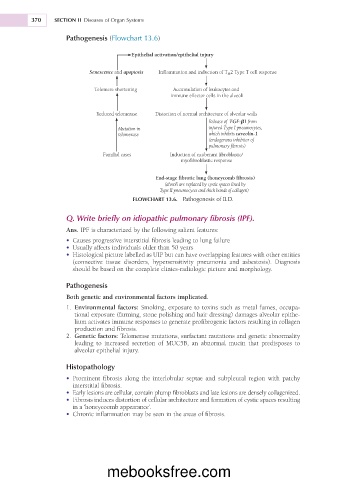
                     Pathogenesis (Flowchart 13.6)


                                          Epithelial activation/epithelial injury

                             Senescence and apoptosis  Inflammation and induction of T 2 Type T cell response
                                                                       H

                              Telomere shortening     Accumulation of leukocytes and
                                                      immune effector cells in the alveoli

                               Reduced telomerase  Distortion of normal architecture of alveolar walls
                                                                 Release of TGF- 1 from
                                     Mutation in                 injured Type I pneumocytes,
                                     telomerase                  which inhibits caveolin-1
                                                                 (endogenous inhibitor of
                                                                 pulmonary fibrosis)
                                 Familial cases      Induction of exuberant fibroblastic/
                                                         myofibroblastic response


                                                 End-stage fibrotic lung (honeycomb fibrosis)
                                                    (alveoli are replaced by cystic spaces lined by
                                                  Type II pneumocytes and thick bands of collagen)
                                          FLOWCHART 13.6.  Pathogenesis of ILD.

                     Q. Write briefly on idiopathic pulmonary fibrosis (IPF).

                     Ans. IPF is characterized by the following salient features:
                     •  Causes progressive interstitial fibrosis leading to lung failure
                     •  Usually affects individuals older than 50 years
                     •  Histological picture labelled as UIP but can have overlapping features with other entities
                       (connective  tissue  disorders,  hypersensitivity  pneumonia  and  asbestosis).  Diagnosis
                       should be based on the complete clinics-radiologic picture and morphology.

                     Pathogenesis
                     Both genetic and environmental factors implicated.
                       1.  Environmental factors: Smoking, exposure to toxins such as metal fumes, occupa-
                        tional exposure (farming, stone polishing and hair dressing) damages alveolar epithe-
                        lium activates immune responses to generate profibrogenic factors resulting in collagen
                        production and fibrosis.
                       2.  Genetic factors: Telomerase mutations, surfactant mutations and genetic abnormality
                        leading  to  increased  secretion  of  MUC5B,  an  abnormal  mucin  that  predisposes  to
                        alveolar epithelial injury.

                     Histopathology
                     •  Prominent  fibrosis  along  the  interlobular  septae  and  subpleural  region  with  patchy
                       interstitial fibrosis.
                     •  Early lesions are cellular, contain plump fibroblasts and late lesions are densely collagenized.
                     •  Fibrosis induces distortion of cellular architecture and formation of cystic spaces resulting
                       in a ‘honeycoomb appearance’.
                     •  Chronic inflammation may be seen in the areas of fibrosis.


                                  mebooksfree.com

