


Page 381 - Concise Pathology for Exam Preparation ( PDFDrive )
P. 381
366    SECTION II  Diseases of Organ Systems

                     Q. Differentiate between centriacinar and panacinar emphysema.

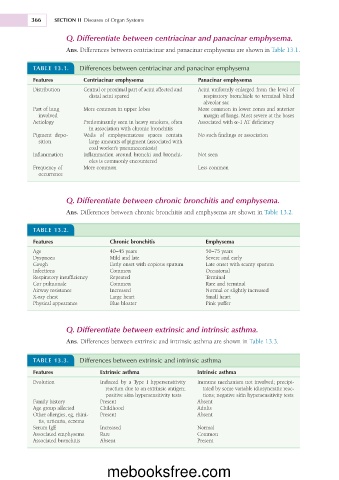
                     Ans. Differences between centriacinar and panacinar emphysema are shown in Table 13.1.

           TABLE 13.1.   Differences between centriacinar and panacinar emphysema

           Features        Centriacinar emphysema             Panacinar emphysema
           Distribution    Central or proximal part of acini affected and   Acini uniformly enlarged from the level of
                            distal acini spared                 respiratory bronchiole to terminal blind
                                                                alveolar sac
           Part of lung    More common in upper lobes         More common in lower zones and anterior
             involved                                           margin of lungs. Most severe at the bases
           Aetiology       Predominantly seen in heavy smokers, often   Associated with a-1 AT deficiency
                            in association with chronic bronchitis
           Pigment  depo-  Walls  of  emphysematous  spaces  contain   No such findings or association
             sition         large amounts of pigment (associated with
                            coal worker’s pneumoconiosis)
           Inflammation    Inflammation around bronchi and bronchi-  Not seen
                            oles is commonly encountered
           Frequency of    More common                        Less common
             occurrence


                     Q. Differentiate between chronic bronchitis and emphysema.
                     Ans. Differences between chronic bronchitis and emphysema are shown in Table 13.2.


           TABLE 13.2.   Differences between chronic bronchitis and emphysema
           Features                Chronic bronchitis           Emphysema
           Age                     40–45 years                  50–75 years
           Dyspnoea                Mild and late                Severe and early
           Cough                   Early onset with copious sputum  Late onset with scanty sputum
           Infections              Common                       Occasional
           Respiratory insufficiency  Repeated                  Terminal
           Cor pulmonale           Common                       Rare and terminal
           Airway resistance       Increased                    Normal or slightly increased
           X-ray chest             Large heart                  Small heart
           Physical appearance     Blue bloater                 Pink puffer


                     Q. Differentiate between extrinsic and intrinsic asthma.

                     Ans. Differences between extrinsic and intrinsic asthma are shown in Table 13.3.


           TABLE 13.3.   Differences between extrinsic and intrinsic asthma
           Features             Extrinsic asthma              Intrinsic asthma
           Evolution            Induced  by  a  Type  I  hypersensitivity   Immune mechanism not involved; precipi-
                                  reaction due to an extrinsic antigen;   tated by some variable idiosyncratic reac-
                                  positive skin hypersensitivity tests  tions; negative skin hypersensitivity tests
           Family history       Present                       Absent
           Age group affected   Childhood                     Adults
           Other allergies, eg, rhini-  Present               Absent
             tis, urticaria, eczema
           Serum IgE            Increased                     Normal
           Associated emphysema  Rare                         Common
           Associated bronchitis  Absent                      Present


                                  mebooksfree.com

