


Page 380 - Concise Pathology for Exam Preparation ( PDFDrive )
P. 380
13  The Lung  365


               presentation of bronchiectasis, while the latter is most often associated with systemic
               illnesses.
             •  The bronchi and bronchioles are dilated and can be traced up to the pleural surface.
             •  The wall of the bronchi is thickened due to fibrosis and the lumen may be filled with
               mucopurulent secretions.
             •  Reid characterized bronchiectasis as cylindrical, cystic or varicose based on mor-
               phology:
               •  Cylindrical  bronchiectasis:  Bronchi  are  dilated  minimally  and  have  straight,  regular
                 outlines (primarily due to mucosal oedema)
               •  Cystic or saccular bronchiectasis: Bronchi have a ballooned appearance and demon-
                 strate air-fluid levels (due to ulceration with bronchial neovascularization).
               •  Varicose  bronchiectasis:  Bulbous  bronchi  with  dilatations  and  intervening  sites  of
                 relative constriction due to scarring.
             Microscopy
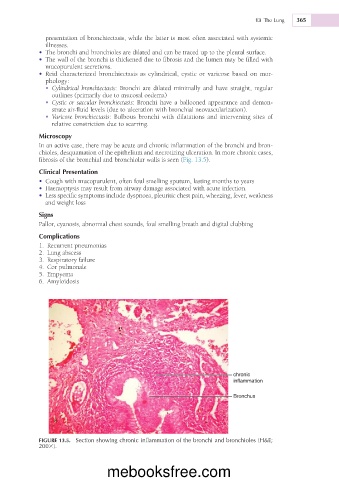
             In an active case, there may be acute and chronic inflammation of the bronchi and bron-
             chioles, desquamation of the epithelium and necrotizing ulceration. In more chronic cases,
             fibrosis of the bronchial and bronchiolar walls is seen (Fig. 13.5).
             Clinical Presentation
             •  Cough with mucopurulent, often foul smelling sputum, lasting months to years
             •  Haemoptysis may result from airway damage associated with acute infection.
             •  Less specific symptoms include dyspnoea, pleuritic chest pain, wheezing, fever, weakness
               and weight loss
             Signs
             Pallor, cyanosis, abnormal chest sounds, foul smelling breath and digital clubbing

             Complications
               1.  Recurrent pneumonias
               2.  Lung abscess
               3.  Respiratory failure
               4.  Cor pulmonale
               5.  Empyema
               6.  Amyloidosis


                                                                         chronic
                                                                         inflammation


                                                                         Bronchus


             FIGURE 13.5.  Section showing chronic inflammation of the bronchi and bronchioles (H&E;
             2003).


                                  mebooksfree.com

