


Page 390 - Concise Pathology for Exam Preparation ( PDFDrive )
P. 390
13  The Lung  375


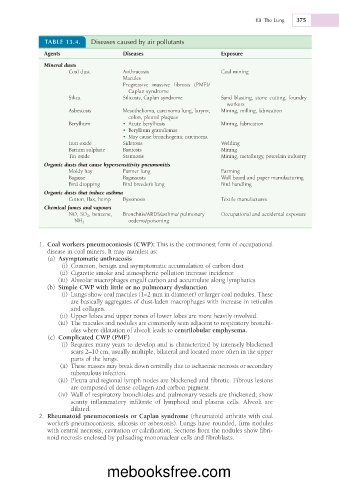
               TABLE 13.4.   Diseases caused by air pollutants

               Agents                  Diseases                      Exposure
               Mineral dusts
                      Coal dust        Anthracosis                   Coal mining
                                       Macules
                                       Progressive  massive  fibrosis  (PMF)/
                                         Caplan syndrome
                      Silica           Silicosis, Caplan syndrome    Sand  blasting,  stone  cutting,  foundry
                                                                       workers
                      Asbestosis       Mesothelioma, carcinoma lung, larynx,   Mining, milling, fabrication
                                         colon, pleural plaques
                      Beryllium        •  Acute berylliosis          Mining, fabrication
                                       •  Beryllium granulomas
                                       •  May cause bronchogenic carcinoma
                      Iron oxide       Siderosis                     Welding
                      Barium sulphate  Baritosis                     Mining
                      Tin oxide        Stannosis                     Mining, metallurgy, porcelain industry
               Organic dusts that cause hypersensitivity pneumonitis
                      Moldy hay        Farmer lung                   Farming
                      Bagasse          Bagassosis                    Wall board and paper manufacturing
                      Bird dropping    Bird breeder’s lung           Bird handling
               Organic dusts that induce asthma
                      Cotton, flax, hemp  Byssinosis                 Textile manufactures
               Chemical fumes and vapours
                      NO, SO 2 , benzene,   Bronchitis/ARDS/asthma/ pulmonary   Occupational and accidental exposure
                        NH 3             oedema/poisoning


               1.  Coal workers pneumoconiosis (CWP): This is the commonest form of occupational
                disease in coal miners. It may manifest as:
                 (a)  Asymptomatic anthracosis
                     (i)  Common, benign and asymptomatic accumulation of carbon dust
                    (ii)  Cigarette smoke and atmospheric pollution increase incidence
                     (iii)  Alveolar macrophages engulf carbon and accumulate along lymphatics
                 (b)  Simple CWP with little or no pulmonary dysfunction
                     (i)  Lungs show coal macules (1–2 mm in diameter) or larger coal nodules. These
                       are basically aggregates of dust-laden macrophages with increase in reticulin
                       and collagen.
                    (ii)  Upper lobes and upper zones of lower lobes are more heavily involved.
                     (iii)  The macules and nodules are commonly seen adjacent to respiratory bronchi-
                       oles where dilatation of alveoli leads to centrilobular emphysema.
                 (c)  Complicated CWP (PMF)
                     (i)  Requires many years to develop and is characterized by intensely blackened
                       scars 2–10 cm, usually multiple, bilateral and located more often in the upper
                       parts of the lungs.
                    (ii)  These masses may break down centrally due to ischaemic necrosis or secondary
                       tuberculous infection.
                     (iii)  Pleura and regional lymph nodes are blackened and fibrotic. Fibrous lesions
                       are composed of dense collagen and carbon pigment.
                    (iv)  Wall of respiratory bronchioles and pulmonary vessels are thickened; show
                       scanty  inflammatory  infiltrate  of  lymphoid  and  plasma  cells.  Alveoli  are
                       dilated.
               2.  Rheumatoid pneumoconiosis or Caplan syndrome (rheumatoid arthritis with coal
                worker’s pneumoconiosis, silicosis or asbestosis). Lungs have rounded, firm nodules
                with central necrosis, cavitation or calcification. Sections from the nodules show fibri-
                noid necrosis enclosed by palisading mononuclear cells and fibroblasts.


                                  mebooksfree.com

