


Page 391 - Concise Pathology for Exam Preparation ( PDFDrive )
P. 391
376    SECTION II  Diseases of Organ Systems


                        Clinical course of pneumoconiosis
                        •  Simple coal worker’s pneumoconiosis usually has a benign course; PMF may lead to
                          cor pulmonale in a few patients.
                        •  Coal dust exposure increases the incidence of chronic bronchitis and emphysema.
                        Predisposing factors implicated in the development of PMF:
                        •  Older age of the miners
                        •  Amount and duration of exposure to coal dust
                        •  Coexisting tuberculosis
                        •  Coexisting silicosis may further damage the lungs by the following mechanisms:
                          •  Free radical generation (reactive oxygen species that damage the lung parenchyma)
                          •  Release of chaemotactic factors, which induce infiltration of inflammatory cells
                            into pulmonary tissue
                          •  Release of fibrogenic cytokines—IL-1, TNF and PDGF—which cause healing by
                            fibrosis
                       3.  Silicosis (knife grinder’s lung disease)
                         (a)  Most prevalent chronic occupational lung disease
                         (b)  Silica has two forms: crystalline and amorphous; the crystalline forms (quartz, cristo-
                           balite and tridymite) are more fibrogenic and toxic than the noncrystalline forms
                         (c)  Prolonged exposure leads to nodular fibrosing pneumoconiosis
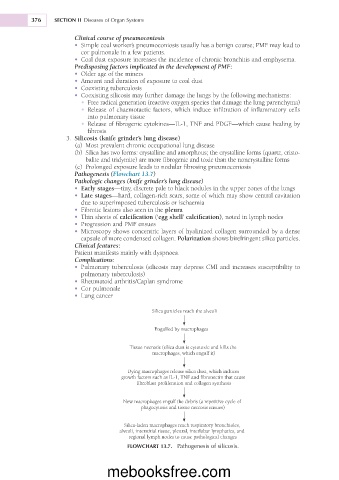
                        Pathogenesis (Flowchart 13.7)
                        Pathologic changes (knife grinder’s lung disease)
                        •  Early stages—tiny, discrete pale to black nodules in the upper zones of the lungs
                        •  Late stages—hard, collagen-rich scars, some of which may show central cavitation
                          due to superimposed tuberculosis or ischaemia
                        •  Fibrotic lesions also seen in the pleura
                        •  Thin sheets of calcification (‘egg shell’ calcification), noted in lymph nodes
                        •  Progression and PMF ensues
                        •  Microscopy shows concentric layers of hyalinized collagen surrounded by a dense
                          capsule of more condensed collagen. Polarization shows birefringent silica particles.
                        Clinical features:
                        Patient manifests mainly with dyspnoea.
                        Complications:
                        •  Pulmonary tuberculosis (silicosis may depress CMI and increases susceptibility to
                          pulmonary tuberculosis)
                        •  Rheumatoid arthritis/Caplan syndrome
                        •  Cor pulmonale
                        •  Lung cancer

                                                Silica particles reach the alveoli


                                                 Engulfed by macrophages

                                         Tissue necrosis (silica dust is cytotoxic and kills the
                                                macrophages, which engulf it)


                                        Dying macrophages release silica dust, which induces
                                      growth factors such as IL-1, TNF and fibronectin that cause
                                           fibroblast proliferation and collagen synthesis


                                       New macrophages engulf the debris (a repetitive cycle of
                                            phagocytosis and tissue necrosis ensues)

                                       Silica-laden macrophages reach respiratory bronchioles,
                                      alveoli, interstitial tissue, pleural, interlobar lymphatics, and
                                         regional lymph nodes to cause pathological changes
                                        FLOWCHART 13.7.  Pathogenesis of silicosis.


                                  mebooksfree.com

