


Page 428 - Concise Pathology for Exam Preparation ( PDFDrive )
P. 428
14  The Oral Cavity and Gastrointestinal Tract  413


             Histology
             •	 Stalk covered by normal colonic mucosa whereas the head is composed of branching
               glands lined by dysplastic epithelium, which may or may not be mucin secreting.
             •	 All degrees of atypia may be encountered. Cancer may be limited to mucosa (intramucosal
               carcinoma) or be frankly invasive, extending into the submucosa of the stalk.

             Villous adenomas
             •	 Finger-like polyps, which are larger than most epithelial polyps
             •	 Usually seen in the rectosigmoid; generally, sessile and velvety or cauliflower-like
             Histology
             •	 Filiform extensions of mucosa covered by dysplastic epithelium
             •	 All degrees of dysplasia may be encountered
             •	 Invasive carcinoma is seen in about 40% of these lesions

             Tubulovillous adenomas
             •	 Show an admixture of tubular and villous areas
             •	 They are intermediate between tubular and villous adenomas in terms of their histology
               and behaviour

             Sessile serrated adenomas
             •	 Premalignant sessile lesions of colon
             •	 Overlap histologically with hyperplastic polyps but unlike hyperplastic polyps have a
               serrated architecture through the entire length of the gland (in hyperplastic polyps the
               serrated architecture is limited to the surface of the gland)


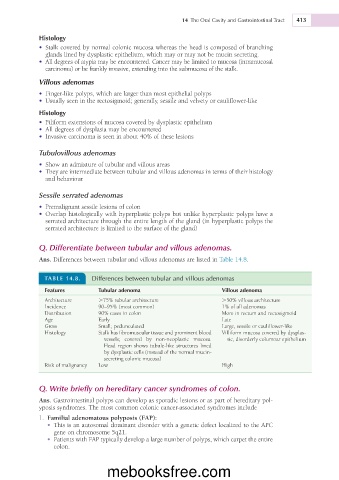
             Q. Differentiate between tubular and villous adenomas.
             Ans. Differences between tubular and villous adenomas are listed in Table 14.8.


               TABLE 14.8.   Differences between tubular and villous adenomas
               Features        Tubular adenoma                       Villous adenoma
               Architecture    .75% tubular architecture             .50% villous architecture
               Incidence       90–95% (most common)                  1% of all adenomas
               Distribution    90% cases in colon                    More in rectum and rectosigmoid
               Age             Early                                 Late
               Gross           Small; pedunculated                   Large, sessile or cauliflower-like
               Histology       Stalk has fibromuscular tissue and prominent blood   Villiform mucosa covered by dysplas-
                                 vessels;  covered  by  non-neoplastic  mucosa.   tic, disorderly columnar epithelium
                                 Head region  shows  tubule-like structures lined
                                 by dysplastic cells (instead of the normal mucin-
                                 secreting colonic mucosa)
               Risk of malignancy  Low                               High


             Q. Write briefly on hereditary cancer syndromes of colon.
             Ans. Gastrointestinal polyps can develop as sporadic lesions or as part of hereditary pol-
             yposis syndromes. The most common colonic cancer-associated syndromes include
               1.  Familial	adenomatous	polyposis	(FAP):
                •	 This is an autosomal dominant disorder with a genetic defect localized to the APC
                  gene on chromosome 5q21.
                •	 Patients with FAP typically develop a large number of polyps, which carpet the entire
                  colon.


                                  mebooksfree.com

