


Page 430 - Concise Pathology for Exam Preparation ( PDFDrive )
P. 430
14  The Oral Cavity and Gastrointestinal Tract  415


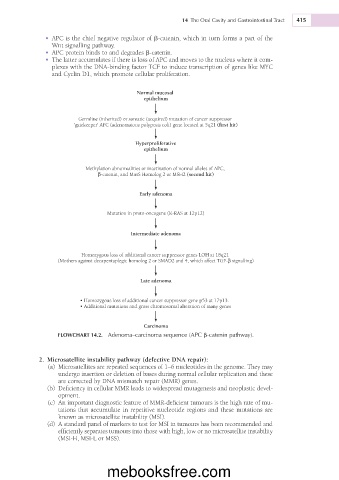
               •	 APC is the chief negative regulator of b-catenin, which in turn forms a part of the
                 Wnt signalling pathway.
               •	 APC protein binds to and degrades b-catenin.
               •	 The latter accumulates if there is loss of APC and moves to the nucleus where it com-
                 plexes with the DNA-binding factor TCF to induce transcription of genes like MYC
                 and Cyclin D1, which promote cellular proliferation.

                                           Normal mucosal
                                             epithelium


                         Germline (inherited) or somatic (acquired) mutation of cancer suppressor
                        ‘gatekeeper’ APC (adenomatous polyposis coli) gene located at 5q21 (first hit)

                                           Hyperproliferative
                                             epithelium


                           Methylation abnormalities or inactivation of normal alleles of APC,
                               β-catenin, and MutS Homolog 2 or MSH2 (second hit)


                                            Early adenoma

                                  Mutation in proto-oncogene (K-RAS at 12p12)


                                         Intermediate adenoma


                          Homozygous loss of additional cancer suppressor genes LOH at 18q21
                   (Mothers against decapentaplegic homolog 2 or SMAD2 and 4, which affect TGF-β signalling)

                                            Late adenoma


                          • Homozygous loss of additional cancer suppressor gene p53 at 17p13.
                          • Additional mutations and gross chromosomal alteration of many genes


                                             Carcinoma
                   FLOWCHART 14.2.  Adenoma–carcinoma sequence (APC b-catenin pathway).


             	 2.	 Microsatellite	instability	pathway	(defective	DNA	repair):
                 (a)  Microsatellites are repeated sequences of 1–6 nucleotides in the genome. They may
                   undergo insertion or deletion of bases during normal cellular replication and these
                   are corrected by DNA mismatch repair (MMR) genes.
                 (b)  Deficiency in cellular MMR leads to widespread mutagenesis and neoplastic devel-
                   opment.
                 (c)  An important diagnostic feature of MMR-deficient tumours is the high rate of mu-
                   tations that accumulate in repetitive nucleotide regions and these mutations are
                   known as microsatellite instability (MSI).
                 (d)  A standard panel of markers to test for MSI in tumours has been recommended and
                   efficiently separates tumours into those with high, low or no microsatellite instability
                   (MSI-H, MSI-L or MSS).


                                  mebooksfree.com

