


Page 431 - Concise Pathology for Exam Preparation ( PDFDrive )
P. 431
416
           416    SECTION II  Diseases of Organ Systems
                     Gross Morphology

                     Can be found anywhere in the colon and are typically seen as exophytic polypoid (right-side
                     colon) or annular constricting (left-side colon) growths

                     Microscopic Features

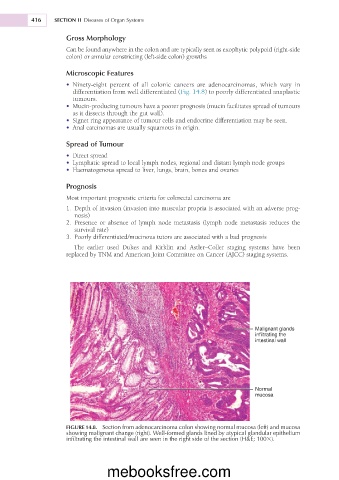
                     •	 Ninety-eight  percent  of  all  colonic  cancers  are  adenocarcinomas,  which  vary  in
                       differentiation from well differentiated (Fig. 14.8) to poorly differentiated anaplastic
                       tumours.
                     •	 Mucin-producing tumours have a poorer prognosis (mucin facilitates spread of tumours
                       as it dissects through the gut wall).
                     •	 Signet ring appearance of tumour cells and endocrine differentiation may be seen.
                     •	 Anal carcinomas are usually squamous in origin.

                     Spread of Tumour
                     •	 Direct spread
                     •	 Lymphatic spread to local lymph nodes, regional and distant lymph node groups
                     •	 Haematogenous spread to liver, lungs, brain, bones and ovaries

                     Prognosis
                     Most important prognostic criteria for colorectal carcinoma are
                       1.  Depth of invasion (invasion into muscular propria is associated with an adverse prog-
                        nosis)
                       2.  Presence  or  absence  of  lymph  node  metastasis  (lymph  node  metastasis  reduces  the
                        survival rate)
                       3.  Poorly differentiated/mucinous tutors are associated with a bad prognosis
                        The  earlier  used  Dukes  and  Kirklin  and  Astler–Coller  staging  systems  have  been
                     replaced by TNM and American Joint Committee on Cancer (AJCC) staging systems.


                                                                                Malignant glands
                                                                                infiltrating the
                                                                                intestinal wall


                                                                                Normal
                                                                                mucosa


                     FIGURE 14.8.  Section from adenocarcinoma colon showing normal mucosa (left) and mucosa
                     showing malignant change (right). Well-formed glands lined by atypical glandular epithelium
                     infiltrating the intestinal wall are seen in the right side of the section (H&E; 1003).


                                  mebooksfree.com

