


Page 426 - Concise Pathology for Exam Preparation ( PDFDrive )
P. 426
14  The Oral Cavity and Gastrointestinal Tract  411


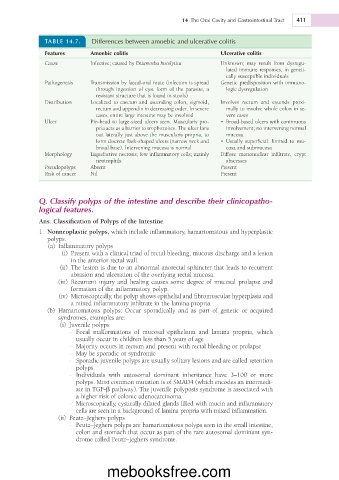
               TABLE 14.7.   Differences between amoebic and ulcerative colitis

               Features      Amoebic colitis                         Ulcerative colitis
               Cause         Infective; caused by Entamoeba histolytica  Unknown;  may  result  from  dysregu-
                                                                       lated immune responses, in geneti-
                                                                       cally susceptible individuals
               Pathogenesis  Transmission by faecal-oral route (infection is spread   Genetic predisposition with immuno-
                               through  ingestion  of  cyst  form  of  the  parasite,  a   logic dysregulation
                               resistant structure that is found in stools)
               Distribution  Localized to caecum and ascending colon, sigmoid,   Involves  rectum  and  extends  proxi-
                               rectum and appendix in decreasing order. In severe   mally to involve whole colon in se-
                               cases, entire large intestine may be involved  vere cases
               Ulcer         Pin-head to large-sized ulcers seen. Muscularis pro-  •  Broad-based ulcers with continuous
                               pria acts as a barrier to trophozoites. The ulcer fans   involvement; no intervening normal
                               out laterally just above the muscularis propria, to   mucosa.
                               form discrete flask-shaped ulcers (narrow neck and   •  Usually  superficial:  limited  to  mu-
                               broad base). Intervening mucosa is normal  cosa and submucosa
               Morphology    Liquefactive necrosis; few inflammatory cells; mainly   Diffuse  mononuclear  infiltrate,  crypt
                               neutrophils                             abscesses
               Pseudopolyps  Absent                                  Present
               Risk of cancer  Nil                                   Present


             Q. Classify polyps of the intestine and describe their clinicopatho-
             logical features.

             Ans.	Classification	of	Polyps	of	the	Intestine
               1.	 Nonneoplastic	polyps,	which include inflammatory, hamartomatous and hyperplastic
                polyps.
                 (a)  Inflammatory polyps
                     (i)  Present with a clinical triad of rectal bleeding, mucous discharge and a lesion
                       in the anterior rectal wall.
                    (ii)  The lesion is due to an abnormal anorectal sphincter that leads to recurrent
                       abrasion and ulceration of the overlying rectal mucosa.
                     (iii)  Recurrent  injury  and  healing  causes  some  degree  of  mucosal  prolapse  and
                       formation of the inflammatory polyp.
                    (iv)  Microscopically, the polyp shows epithelial and fibromuscular hyperplasia and
                       a mixed inflammatory infiltrate in the lamina propria.
                 (b)  Hamartomatous  polyps:  Occur  sporadically  and  as  part  of  genetic  or  acquired
                   syndromes, examples are:
                    (i)  Juvenile polyps
                      -	 Focal  malformations  of  mucosal  epithelium  and  lamina  propria,  which
                        usually occur in children less than 5 years of age
                      -	 Majority occurs in rectum and present with rectal bleeding or prolapse
                      -	 May be sporadic or syndromic
                      -	 Sporadic juvenile polyps are usually solitary lesions and are called retention
                        polyps.
                      -	 Individuals  with  autosomal  dominant  inheritance  have  3–100  or  more
                        polyps. Most common mutation is of SMAD4 (which encodes an intermedi-
                        ate in TGF-b pathway). The juvenile polyposis syndrome is associated with
                        a higher risk of colonic adenocarcinoma.
                      -	 Microscopically, cystically dilated glands filled with mucin and inflammatory
                        cells are seen in a background of lamina propria with mixed inflammation.
                     (ii)  Peutz–Jeghers polyps
                      -	 Peutz–Jeghers polyps are hamartomatous polyps seen in the small intestine,
                        colon and stomach that occur as part of the rare autosomal dominant syn-
                        drome called Peutz–Jeghers syndrome.


                                  mebooksfree.com

