


Page 425 - Concise Pathology for Exam Preparation ( PDFDrive )
P. 425
410
           410    SECTION II  Diseases of Organ Systems

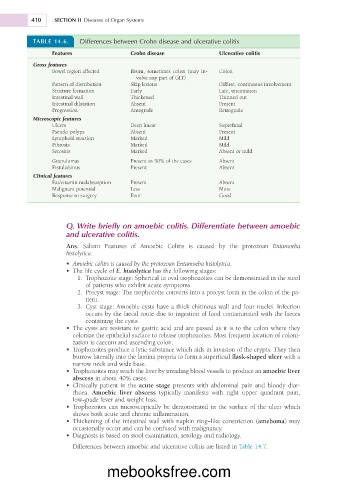
           TABLE 14.6.    Differences between Crohn disease and ulcerative colitis

                 Features                Crohn disease              Ulcerative colitis
           Gross features
                 Bowel region affected   Ileum,  sometimes  colon  (may  in-  Colon
                                           volve any part of GIT)
                 Pattern of distribution  Skip lesions              Diffuse, continuous involvement
                 Stricture formation     Early                      Late, uncommon
                 Intestinal wall         Thickened                  Thinned out
                 Intestinal dilatation   Absent                     Present
                 Progression             Antegrade                  Retrograde
           Microscopic features
                 Ulcers                  Deep linear                Superficial
                 Pseudo polyps           Absent                     Present
                 Lymphoid reaction       Marked                     Mild
                 Fibrosis                Marked                     Mild
                 Serositis               Marked                     Absent or mild
                 Granulomas              Present in 50% of the cases  Absent
                 Fistula/sinus           Present                    Absent
           Clinical features
                 Fat/vitamin malabsorption  Present                 Absent
                 Malignant potential     Less                       More
                 Response to surgery     Poor                       Good


                     Q. Write briefly on amoebic colitis. Differentiate between amoebic
                     and ulcerative colitis.

                     Ans.  Salient  Features  of  Amoebic  Colitis  is  caused  by  the  protozoan  Entamoeba
                     histolytica.
                     •  Amoebic colitis is caused by the protozoan Entamoeba histolytica.
                     •	 The life cycle of E. histolytica has the following stages:
                          1.  Trophozoite stage: Spherical to oval trophozoites can be demonstrated in the stool
                           of patients who exhibit acute symptoms.
                          2.  Precyst stage: The trophozoite converts into a precyst form in the colon of the pa-
                           tient.
                          3.  Cyst stage: Amoebic cysts have a thick chitinous wall and four nuclei. Infection
                           occurs by the faecal route due to ingestion of food contaminated with the faeces
                           containing the cysts.
                     •	 The cysts are resistant to gastric acid and are passed as it is to the colon where they
                       colonize the epithelial surface to release trophozoites. Most frequent location of coloni-
                       zation is caecum and ascending colon.
                     •	 Trophozoites produce a lytic substance which aids in invasion of the crypts. They then
                       burrow laterally into the lamina propria to form a superficial flask-shaped	ulcer	with a
                       narrow neck and wide base.
                     •	 Trophozoites may reach the liver by invading blood vessels to produce an amoebic	liver
                       abscess	in about 40% cases.
                     •	 Clinically patient in the acute	stage	presents with abdominal pain and bloody diar-
                       rhoea.  Amoebic	 liver	 abscess	 typically  manifests  with  right  upper  quadrant  pain,
                       low-grade fever and weight loss.
                     •	 Trophozoites can microscopically be demonstrated in the surface of the ulcer which
                       shows both acute and chronic inflammation.
                     •	 Thickening of the intestinal wall with napkin ring–like constriction (ameboma) may
                       occasionally occur and can be confused with malignancy.
                     •	 Diagnosis is based on stool examination, serology and radiology.
                       Differences between amoebic and ulcerative colitis are listed in Table 14.7.


                                  mebooksfree.com

