


Page 462 - Concise Pathology for Exam Preparation ( PDFDrive )
P. 462
15  Diseases of the Hepatobiliary System and Pancreas  447


                •	 Stones are often present in the neck of the gallbladder or the cystic duct.
                •	 Gallbladder lumen is filled with cloudy or turbid bile with or without admixed pus.
                •	 When the contained exudate becomes pure pus, the condition is called empyema.
                •	 In severe cases, gallbladder is transformed into a green-black	necrotic	organ	(gan-
                  grenous	cholecystitis).
               •	 Histologically, the wall shows oedema, vascular congestion and neutrophilic infiltrate.
               2.  Chronic	cholecystitis
                Salient features:
                •	 May follow repeated attacks of acute cholecystitis or develop without any history of
                  previous attacks.
                •	 Clinically, it presents with recurrent attacks of colicky epigastric or right upper quad-
                  rant pain, nausea, vomiting and intolerance to fatty food.
                •	 Usually associated with gallstones in the lumen or presence of biliary gravel (thick
                  viscous bile with micro-concretions).
                •	 Chronic  acalculus  cholecystitis  causes  symptoms  and  morphological  alterations
                  similar to chronic calculus cholecystitis.
                Pathology:
                •	 Serosa is dull and opaque and may show adhesions.
                •	 Mucosa is oedematous, focally ulcerated or indurated.
                •	 Gallbladder may be contracted, of normal size, or enlarged.
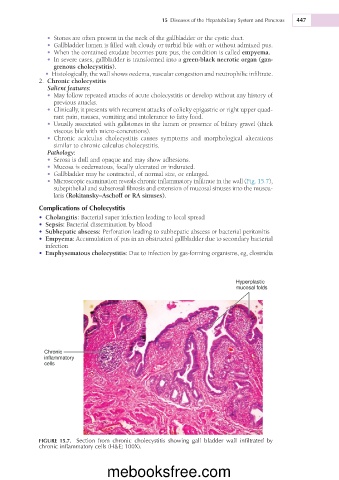
                •	 Microscopic examination reveals chronic inflammatory infiltrate in the wall (Fig. 15.7),
                  subepithelial and subserosal fibrosis and extension of mucosal sinuses into the muscu-
                  laris (Rokitansky–Aschoff	or	RA	sinuses).
             Complications of Cholecystitis
             •	 Cholangitis: Bacterial super infection leading to local spread
             •	 Sepsis: Bacterial dissemination by blood
             •	 Subhepatic	abscess: Perforation leading to subhepatic abscess or bacterial peritonitis
             •	 Empyema: Accumulation of pus in an obstructed gallbladder due to secondary bacterial
               infection
             •	 Emphysematous	cholecystitis: Due to infection by gas-forming organisms, eg, clostridia


                                                                          Hyperplastic
                                                                          mucosal folds


               Chronic
               inflammatory
               cells


             FIGURE  15.7.  Section  from  chronic  cholecystitis  showing  gall  bladder  wall  infiltrated  by
             chronic inflammatory cells (H&E; 100X).


                                  mebooksfree.com

