


Page 461 - Concise Pathology for Exam Preparation ( PDFDrive )
P. 461
446    SECTION II  Diseases of Organ Systems


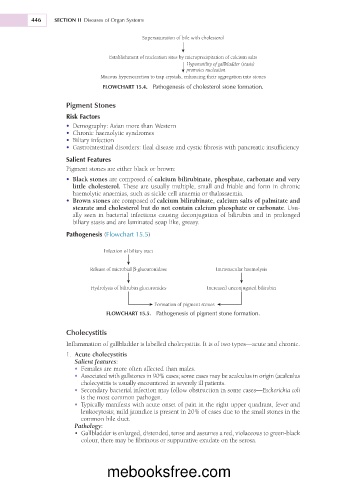
                                             Supersaturation of bile with cholesterol

                                   Establishment of nucleation sites by microprecipitation of calcium salts
                                                          Hypomotility of gallbladder (stasis)
                                                          promotes nucleation
                                Mucous hypersecretion to trap crystals, enhancing their aggregation into stones
                                 FLOWCHART 15.4.  Pathogenesis of cholesterol stone formation.

                     Pigment Stones

                     Risk Factors
                     •	 Demography: Asian more than Western
                     •	 Chronic haemolytic syndromes
                     •	 Biliary infection
                     •	 Gastrointestinal disorders: Ileal disease and cystic fibrosis with pancreatic insufficiency
                     Salient Features
                     Pigment stones are either black or brown:
                     •	 Black	stones are composed of calcium	bilirubinate,	phosphate,	carbonate	and	very
                       little	cholesterol. These are usually multiple, small and friable and form in chronic
                       haemolytic anaemias, such as sickle cell anaemia or thalassaemia.
                     •	 Brown	stones are composed of calcium	bilirubinate,	calcium	salts	of	palmitate	and
                       stearate	and	cholesterol	but	do	not contain	calcium	phosphate	or	carbonate. Usu-
                       ally seen in bacterial infections causing deconjugation of bilirubin and in prolonged
                       biliary stasis and are laminated soap like, greasy.
                     Pathogenesis (Flowchart 15.5)


                                 Infection of biliary tract

                             Release of microbial β-glucuronidase  Intravascular haemolysis


                             Hydrolysis of bilirubin glucuronides  Increased unconjugated bilirubin

                                                 Formation of pigment stones
                                  FLOWCHART 15.5.  Pathogenesis of pigment stone formation.

                     Cholecystitis
                     Inflammation of gallbladder is labelled cholecystitis. It is of two types—acute and chronic.
                       1.  Acute	cholecystitis
                        Salient features:
                        •	 Females are more often affected than males.
                        •	 Associated with gallstones in 90% cases; some cases may be acalculus in origin (acalculus
                          cholecystitis is usually encountered in severely ill patients.
                        •	 Secondary bacterial infection may follow obstruction in some cases—Escherichia coli
                          is the most common pathogen.
                        •	 Typically manifests with acute onset of pain in the right upper quadrant, fever and
                          leukocytosis; mild jaundice is present in 20% of cases due to the small stones in the
                          common bile duct.
                        Pathology:
                        •  Gallbladder is enlarged, distended, tense and assumes a red, violaceous to green-black
                          colour, there may be fibrinous or suppurative exudate on the serosa.


                                  mebooksfree.com

