


Page 464 - Concise Pathology for Exam Preparation ( PDFDrive )
P. 464
15  Diseases of the Hepatobiliary System and Pancreas  449

             Cells Forming the Islets of Langerhans

             •	 Alpha cells: Secrete glucagon (increases blood glucose)
             •	 Beta cells: Secrete insulin (lowers blood glucose)
             •	 Delta cells: Secrete somatostatin (inhibit the secretion of other islet hormones)
             •	 Delta-1  cells:  Secrete  vasoactive  intestinal  polypeptide  (VIP),  which  regulates  and
               stimulates the motility of intestines
             •	 PP cells: Secrete pancreatic polypeptide (stimulate gastric secretion and inhibit intestinal
               mobility)

             Q. Write briefly on the clinicopathological features of acute pancreatitis.
             Ans. Acute pancreatitis is defined as acute inflammation of the pancreas usually resulting
             from injury to the exocrine pancreas.

             Causes
             •	 Metabolic: Hyperlipoproteinaemias, hypercalcaemia, alcoholism, drugs (eg, diuretics,
               azathioprine and mercaptopurine)
             •	 Genetic:
               •	 Inherited  mutations  in  genes  encoding  pancreatic  enzymes  or  their  inhibitors,
                 eg,  SPINK1  (serine  peptidase  inhibitor  Kazal  type  1)  which  is  an  inhibitor  of
                 trypsin.
               •	 Hereditary pancreatitis with trypsinogen mutation is an autosomal dominant disease
                 caused by a mutation in PRSS1 gene that affects a site on trypsinogen molecule re-
                 quired  for  cleavage  of  trypsin,  leading  to  continuous  activation  of  other  digestive
                 proenzymes and development of pancreatitis.
             •	 Mechanical: Trauma (seat-belt injury), gallstones, injury during endoscopic procedures
               like endoscopic retrograde cholangiopancreatography (ERCP) or perioperative injury
             •	 Vascular: Shock, embolus and polyarteritis nodosa
             •	 Infections: Mumps, coxsackie virus, mycoplasma pneumoniae, EBV and CMV
             •	 Idiopathic	pancreatitis: Occurs without any obvious cause and accounts for 10% of the
               cases, and is the most common cause of pancreatitis (after alcohol and biliary disease)
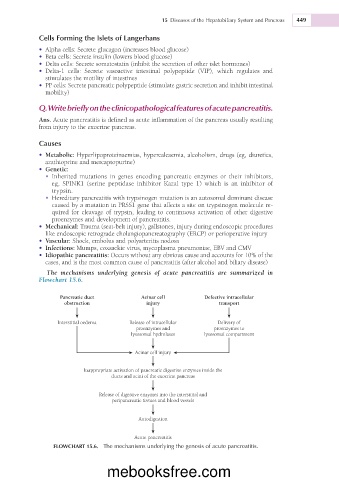
               The  mechanisms  underlying  genesis  of  acute  pancreatitis  are  summarized  in
             Flowchart 15.6.


                    Pancreatic duct         Acinar cell         Defective intracellular
                     obstruction              injury                transport

                   Interstitial oedema   Release of intracellular   Delivery of
                                           proenzymes and          proenzymes to
                                         lysosomal hydrolases   lysosomal compartment

                                           Acinar cell injury


                           Inappropriate activation of pancreatic digestive enzymes inside the
                                   ducts and acini of the exocrine pancreas

                               Release of digestive enzymes into the interstitial and
                                   peripancreatic tissues and blood vessels


                                            Autodigestion


                                          Acute pancreatitis
                 FLOWCHART 15.6.  The mechanisms underlying the genesis of acute pancreatitis.


                                  mebooksfree.com

