


Page 505 - Concise Pathology for Exam Preparation ( PDFDrive )
P. 505
490    SECTION II  Diseases of Organ Systems

                     •	  An  undescended  testis  is  called  retractile  when  it  can  be  manipulated  into  scrotum
                       where it remains without tension. On the other hand, when it can be manipulated into
                       upper scrotum but retracts when released, it is called gliding.
                     •	  Cryptorchidism is unilateral in about 80% cases and bilateral in the remaining. Most
                       cases are clinically asymptomatic and discovered only on physical examination.
                     •	  Cryptorchid testes can be brought into the scrotum by a surgical procedure called an
                       ‘orchiopexy’.
                     •	  Untreated  cases  may  be  associated  with  reduced  fertility,  increased  risk  of  testicular
                       germ cell tumours and are also more prone to torsion, infarction and inguinal hernia.
                     •	  On gross examination, the cryptorchid testis is small and fibrotic. Histologically, there
                       is marked reduction in the number of germ cells.


                     Q. Write briefly on testicular atrophy.
                     Ans.	  Testicular atrophy is a regressive change which can have a varied aetiology.
                     Causes

                     •	  Progressive atherosclerotic narrowing of testicular blood vessels, as in old age
                     •	  End stage of all inflammatory conditions (orchitis)
                     •	  Cryptorchidism
                     •	  Hypopituitarism
                     •	  Obstruction of flow to semen
                     •	  Malnutrition and cachexia
                     •	  Prolonged administration of female sex hormones
                     •	  Exhaustion atrophy due to high level of pituitary follicle-stimulating hormone
                     •	  Klinefelter syndrome
                     Gross Morphology

                     Testes are small in size and firm in consistency due to fibrotic changes.
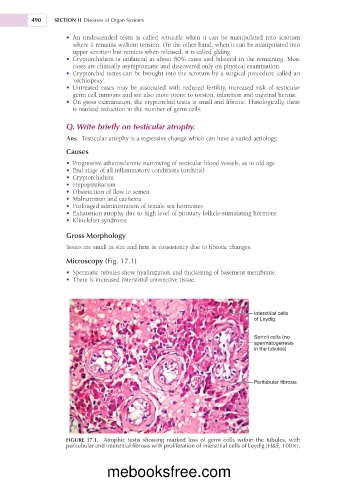
                     Microscopy (Fig. 17.1)

                     •	  Spermatic tubules show hyalinization and thickening of basement membrane.
                     •	  There is increased interstitial connective tissue.


                                                                               Interstitial cells
                                                                               of Leydig

                                                                               Sertoli cells (no
                                                                               spermatogenesis
                                                                               in the tubules)


                                                                               Peritubular fibrosis


                     FIGURE  17.1.  Atrophic  testis  showing  marked  loss  of  germ  cells  within  the  tubules,  with
                     peritubular and interstitial fibrosis with proliferation of interstitial cells of Leydig (H&E; 1003).


                                  mebooksfree.com

