


Page 502 - Concise Pathology for Exam Preparation ( PDFDrive )
P. 502
16  Diseases of the Kidney and Lower Urinary Tract  487

             Q. Write briefly on urothelial (transitional cell) tumours.

             Ans.  Tumours of urinary bladder include
               1.  Urothelial (transitional cell) tumours
                 (a)  Exophytic papilloma
                 (b)  Inverted papilloma
                 (c)  Papillary urothelial neoplasms of low malignant potential
                  (d)  Low-grade and high-grade papillary urothelial cancers
                 (e)  Carcinoma in situ (CIS or flat non-invasive urothelial carcinoma)
               2.  Mixed carcinoma
               3.  Adenocarcinoma
               4.  Small cell carcinoma
               5.  Sarcomas
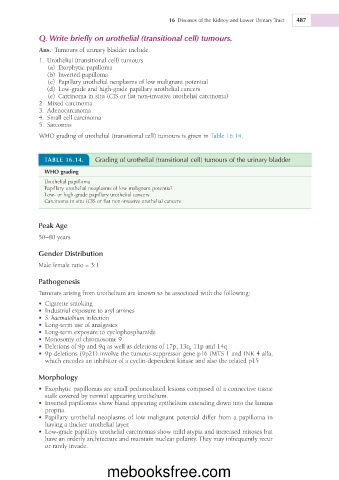
             WHO grading of urothelial (transitional cell) tumours is given in Table 16.14.


               TABLE 16.14.   Grading of urothelial (transitional cell) tumours of the urinary bladder
               WHO grading
               Urothelial papilloma
               Papillary urothelial neoplasms of low malignant potential
               Low- or high-grade papillary urothelial cancers
               Carcinoma in situ (CIS or flat non-invasive urothelial cancers


             Peak Age

             50–80 years

             Gender Distribution
             Male:female ratio = 3:1

             Pathogenesis

             Tumours arising from urothelium are known to be associated with the following:
             •  Cigarette smoking
             •  Industrial exposure to aryl amines
             •  S. haematobium infection
             •  Long-term use of analgesics
             •  Long-term exposure to cyclophosphamide
             •  Monosomy of chromosome 9
             •  Deletions of 9p and 9q as well as deletions of 17p, 13q, 11p and 14q
             •  9p deletions (9p21) involve the tumour-suppressor gene p16 (MTS 1 and INK 4 alfa,
               which encodes an inhibitor of a cyclin-dependent kinase and also the related p15

             Morphology
             •  Exophytic papillomas are small pedunculated lesions composed of a connective tissue
               stalk covered by normal appearing urothelium.
             •  Inverted papillomas show bland appearing epithelium extending down into the lamina
               propria.
             •  Papillary urothelial neoplasms of low malignant potential differ from a papilloma in
               having a thicker urothelial layer.
             •  Low-grade papillary urothelial carcinomas show mild atypia and increased mitoses but
               have an orderly architecture and maintain nuclear polarity. They may infrequently recur
               or rarely invade.


                                  mebooksfree.com

