


Page 507 - Concise Pathology for Exam Preparation ( PDFDrive )
P. 507
492    SECTION II  Diseases of Organ Systems


                         -	 Stage II: Spread confined to retroperitoneal lymph nodes below the diaphragm
                         -	 Stage  III:  Metastasis  outside  the  retroperitoneal  lymph  nodes  or  above  the
                           diaphragm

                     Note: Most seminomas present in Stage I disease; lymph nodes are commonly involved;
                     haematogenous  spread  is  a  late  manifestation.  Most  NSGCTs  present  in  Stage  II  or  III
                     disease; haematogenous spread is an early manifestation.


                     1.  Germ	cell	tumours
                        (a)  Seminomatous	germ	cell	tumours	(SGCTs)
                            (i)  Typical/classical	seminoma	(85%)
                           Clinical features:
                           •	  Most common type of germ cell tumour
                           •	  Peak age: third decade; never seen in infants
                           •	  Extremely radiosensitive
�
                           Gross morphology:
                           •	  Classical seminomas are large tumours which may replace the entire testis but
                             the testicular shape is maintained.
                           •	  Cut surface is homogeneous, grey-white and lobulated.
                           •	  Haemorrhage and necrosis are rare.
                           •	 Tunica albuginea is generally intact; however, occasional extension to epididymis,
                             spermatic cord and scrotal sac may be seen.
�
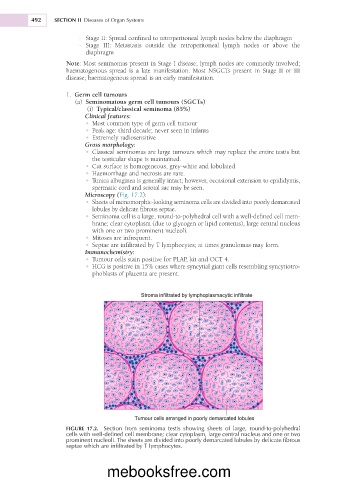
                           Microscopy (Fig. 17.2):
�
                           •	 Sheets of monomorphic-looking seminoma cells are divided into poorly demarcated
                             lobules by delicate fibrous septae.
                           •	  Seminoma cell is a large, round-to-polyhedral cell with a well-defined cell mem-
                             brane; clear cytoplasm (due to glycogen or lipid contents), large central nucleus
                             with one or two prominent nucleoli.
                           •	  Mitoses are infrequent.
                           •	  Septae are infiltrated by T lymphocytes; at times granulomas may form.
                           Immunochemistry:
                           •	  Tumour cells stain positive for PLAP, kit and OCT 4.
                           •	  HCG is positive in 15% cases where syncytial giant cells resembling syncytiotro-
                             phoblasts of placenta are present.


                     FIGURE  17.2.  Section  from  seminoma  testis  showing  sheets  of  large,  round-to-polyhedral
                     cells with well-defined cell membrane; clear cytoplasm, large central nucleus and one or two
                     prominent nucleoli. The sheets are divided into poorly demarcated lobules by delicate fibrous
                     septae which are infiltrated by T lymphocytes.


                                  mebooksfree.com

