


Page 512 - Concise Pathology for Exam Preparation ( PDFDrive )
P. 512
17 Male Genital Tract 497
• The prostate is divided into two parts depending on the hormone responsiveness, the
inner periurethral part which is sensitive to oestrogen and androgens and an outer
subcapsular part that is sensitive to androgen.
Q. Write briefly on the aetiopathogenesis, clinical features and
morphology of nodular hyperplasia of prostate (NHP).
Ans. NHP (benign prostatic hyperplasia) is defined as hyperplasia of prostatic stromal and
epithelial cells, resulting in the formation of discrete nodules in the transitional and inner
periurethral zones (prostate is divided into several zones namely, peripheral, central, tran-
sitional and periurethral). The nodules compress the prostatic urethra to produce the
clinical symptoms of NHP.
• NHP was earlier called ‘benign hypertrophy’, which is a misnomer because the funda-
mental lesion is a hyperplasia and not hypertrophy.
• Age group affected is more than 50 years; incidence increases with increasing age.
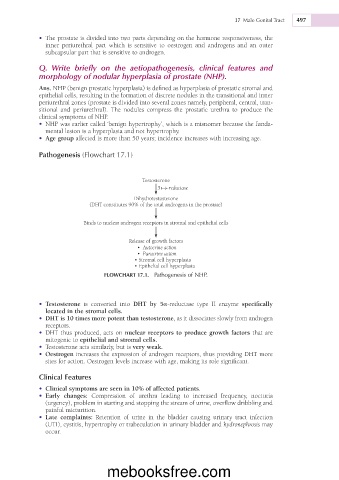
Pathogenesis (Flowchart 17.1)
Testosterone
5 reductase
Dihydrotestosterone
(DHT constitutes 90% of the total androgens in the prostate)
Binds to nuclear androgen receptors in stromal and epithelial cells
Release of growth factors
• Autocrine action
• Paracrine action
• Stromal cell hyperplasia
• Epithelial cell hyperplasia
FLOWCHART 17.1. Pathogenesis of NHP.
• Testosterone is converted into DHT by 5a-reductase type II enzyme specifically
located in the stromal cells.
• DHT is 10 times more potent than testosterone, as it dissociates slowly from androgen
receptors.
• DHT thus produced, acts on nuclear receptors to produce growth factors that are
mitogenic to epithelial and stromal cells.
• Testosterone acts similarly, but is very weak.
• Oestrogen increases the expression of androgen receptors, thus providing DHT more
sites for action. Oestrogen levels increase with age, making its role significant.
Clinical Features
• Clinical symptoms are seen in 10% of affected patients.
• Early changes: Compression of urethra leading to increased frequency, nocturia
(urgency), problem in starting and stopping the stream of urine, overflow dribbling and
painful micturition.
• Late complaints: Retention of urine in the bladder causing urinary tract infection
(UTI), cystitis, hypertrophy or trabeculation in urinary bladder and hydronephrosis may
occur.
mebooksfree.com

