


Page 518 - Concise Pathology for Exam Preparation ( PDFDrive )
P. 518
18  Female Genital System  503

             Fallopian Tube

             •  Average size is 10 cm 3 1 mm; it is divided into four anatomical regions, namely, isthmus,
               ampulla, fimbriae and abdominal opening.
             •  Mucosa  is  lined  by  three  cell  types—ciliated  columnar,  nonciliated  columnar  and
               intercalated cells (inactive secretory cells).
             •  Anterior to the tubes there is insertion of round ligament. Most lateral portion of broad
               ligament is called infundibulopelvic or suspensory ligament and transmits ovarian
               vessels and nerves.

             Nulliparous Uterus

             •  Weighs 30–40 g, with an average size of 7.5 cm 3 5 cm 3 2.5 cm.
             •  It has an inverted flattened pear appearance with the presence of a constriction called
               isthmus.
             •  Anterior peritoneal reflection is at isthmus; posteriorly peritoneum covers the entire
               uterus and passes down to cover the upper portion of the vagina.
             •  Vaginal portion is covered by moist, smooth vaginal epithelium.
             •  Cervical canal is narrow and fusiform.

             Multiparous Uterus

             Weighs 60–70 g, with an average size of 10 cm 3 5 cm 3 4 cm.

             Postmenopausal Uterus

             •  Atrophic/more fibrous
             •  Cervix less prominent
             •  Uterus is anteflexed (sharply bent forward upon vagina)


             Q. Write briefly on cervical intraepithelial neoplasia (CIN).
             Ans.  CIN is a precancerous lesion frequently associated with HPV infection. HPV is a
             sexually transmitted DNA virus which can lead to CIN as well as invasive squamous cell
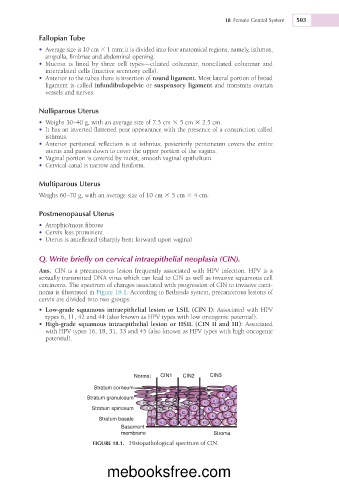
             carcinoma. The spectrum of changes associated with progression of CIN to invasive carci-
             noma is illustrated in Figure 18.1. According to Bethesda system, precancerous lesions of
             cervix are divided into two groups:
             •  Low-grade squamous intraepithelial lesion or LSIL (CIN I): Associated with HPV
               types 6, 11, 42 and 44 (also known as HPV types with low oncogenic potential).
             •  High-grade squamous intraepithelial lesion or HSIL (CIN II and III): Associated
               with HPV types 16, 18, 31, 33 and 45 (also known as HPV types with high oncogenic
               potential).


                                          Normal  CIN1   CIN2     CIN3
                              Stratum corneum
                            Stratum granulosum
                             Stratum spinosum
                               Stratum basale
                                      Basement
                                      membrane                     Stroma
                              FIGURE 18.1.  Histopathological spectrum of CIN.


                                  mebooksfree.com

