


Page 521 - Concise Pathology for Exam Preparation ( PDFDrive )
P. 521
506    SECTION II  Diseases of Organ Systems


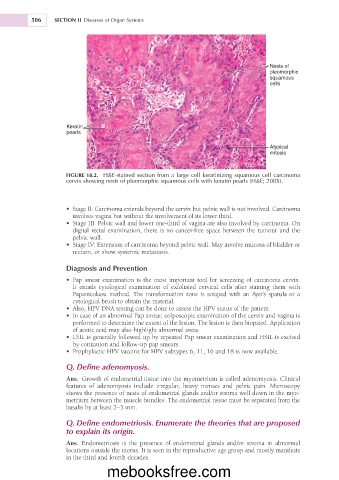
                                                                                    Nests of
                                                                                    pleomorphic
                                                                                    squamous
                                                                                    cells


                     Keratin
                     pearls

                                                                                    Atypical
                                                                                    mitosis


                     FIGURE 18.2.  H&E-stained section from a large cell keratinizing squamous cell carcinoma
                     cervix showing nests of pleomorphic squamous cells with keratin pearls (H&E; 200X).


                     •  Stage II: Carcinoma extends beyond the cervix but pelvic wall is not involved. Carcinoma
                       involves vagina but without the involvement of its lower third.
                     •  Stage III: Pelvic wall and lower one-third of vagina are also involved by carcinoma. On
                       digital rectal examination, there is no cancer-free space between the tumour and the
                       pelvic wall.
                     •  Stage IV: Extension of carcinoma beyond pelvic wall. May involve mucosa of bladder or
                       rectum, or show systemic metastasis.

                     Diagnosis and Prevention
                     •  Pap  smear  examination  is  the  most  important  tool  for  screening  of  carcinoma  cervix.
                       It  entails  cytological  examination  of  exfoliated  cervical  cells  after  staining  them  with
                       Papanicolaou method. The transformation zone is scraped with an Ayer’s spatula or a
                       cytological brush to obtain the material.
                     •  Also, HPV DNA testing can be done to assess the HPV status of the patient.
                     •  In case of an abnormal Pap smear, colposcopic examination of the cervix and vagina is
                       performed to determine the extent of the lesion. The lesion is then biopsied. Application
                       of acetic acid may also highlight abnormal areas.
                     •  LSIL is generally followed up by repeated Pap smear examination and HSIL is excised
                       by conization and follow-up pap smears.
                     •  Prophylactic HPV vaccine for HPV subtypes 6, 11, 16 and 18 is now available.

                     Q. Define adenomyosis.
                     Ans.  Growth of endometrial tissue into the myometrium is called adenomyosis. Clinical
                     features  of  adenomyosis  include  irregular,  heavy  menses  and  pelvic  pain.  Microscopy
                     shows the presence of nests of endometrial glands and/or stroma well down in the myo-
                     metrium between the muscle bundles. The endometrial tissue must be separated from the
                     basalis by at least 2–3 mm.
                     Q. Define endometriosis. Enumerate the theories that are proposed
                     to explain its origin.
                     Ans.  Endometriosis  is  the  presence  of  endometrial  glands  and/or  stroma  in  abnormal
                     locations outside the uterus. It is seen in the reproductive age group and mostly manifests
                     in the third and fourth decades.

                                  mebooksfree.com

