


Page 520 - Concise Pathology for Exam Preparation ( PDFDrive )
P. 520
18  Female Genital System  505


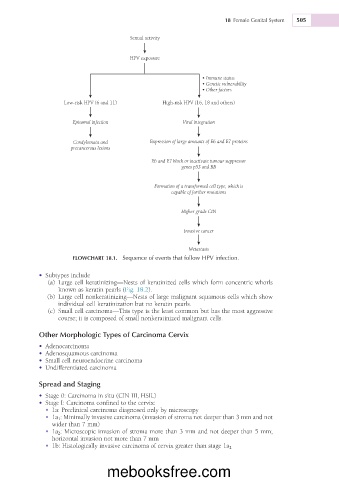
                                         Sexual activity


                                         HPV exposure

                                                               • Immune status
                                                               • Genetic vulnerability
                                                               • Other factors
                     Low-risk HPV (6 and 11)       High-risk HPV (16, 18 and others)


                       Episomal infection                Viral integration


                        Condylomata and        Expression of large amounts of E6 and E7 proteins
                       precancerous lesions
                                                E6 and E7 block or inactivate tumour suppressor
                                                         genes p53 and RB

                                                 Formation of a transformed cell type, which is
                                                      capable of further mutations


                                                         Higher grade CIN


                                                          Invasive cancer

                                                           Metastasis
                       FLOWCHART 18.1.  Sequence of events that follow HPV infection.

             •  Subtypes include
                 (a)  Large cell keratinizing—Nests of keratinized cells which form concentric whorls
                   known as keratin pearls (Fig. 18.2).
                 (b)  Large cell nonkeratinizing—Nests of large malignant squamous cells which show
                   individual cell keratinization but no keratin pearls.
                 (c)  Small cell carcinoma—This type is the least common but has the most aggressive
                   course; it is composed of small nonkeratinized malignant cells.


             Other Morphologic Types of Carcinoma Cervix
             •  Adenocarcinoma
             •  Adenosquamous carcinoma
             •  Small cell neuroendocrine carcinoma
             •  Undifferentiated carcinoma

             Spread and Staging
             •  Stage 0: Carcinoma in situ (CIN III, HSIL)
             •  Stage I: Carcinoma confined to the cervix:
               •  1a: Preclinical carcinoma diagnosed only by microscopy
               •  1a 1 : Minimally invasive carcinoma (invasion of stroma not deeper than 3 mm and not
                 wider than 7 mm)
               •  1a 2 : Microscopic invasion of stroma more than 3 mm and not deeper than 5 mm;
                 horizontal invasion not more than 7 mm
               •  1b: Histologically invasive carcinoma of cervix greater than stage 1a 2


                                  mebooksfree.com

