


Page 524 - Concise Pathology for Exam Preparation ( PDFDrive )
P. 524
18  Female Genital System  509


             Atypical Hyperplasia
             Complex architectural patterns with cellular atypia is the hallmark. Atypical hyperplasia is
             difficult to differentiate from a well-differentiated carcinoma on biopsy. About 20–30% of
             these cases show foci of endometrial carcinoma on hysterectomy.

             Q. Write in detail on the aetiology, clinical features and morphology
             of endometrial carcinoma.

             Ans.  Endometrial carcinoma is the most common cancer of female genital tract. It presents
             with irregular or postmenopausal bleeding and leucorrhoea.

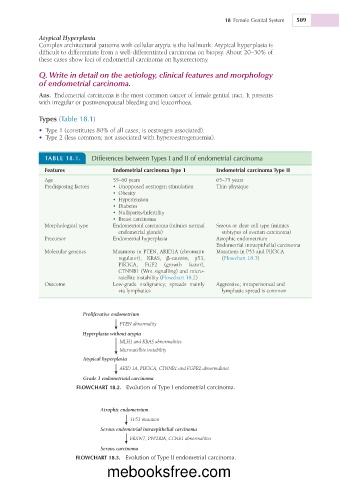
             Types (Table 18.1)
             •  Type 1 (constitutes 80% of all cases; is oestrogen associated).
             •  Type 2 (less common; not associated with hyperoestrogenaemia).


               TABLE 18.1.   Differences between Types I and II of endometrial carcinoma
               Features             Endometrial carcinoma Type 1    Endometrial carcinoma Type II
               Age                  55–60 years                     65–75 years
               Predisposing factors  •  Unopposed oestrogen stimulation  Thin physique
                                    •  Obesity
                                    •  Hypertension
                                    •  Diabetes
                                    •  Nulliparity/infertility
                                    •  Breast carcinoma
               Morphological type   Endometrioid carcinoma (mimics normal   Serous or clear cell type (mimics
                                     endometrial glands)             subtypes of ovarian carcinoma)
               Precursor            Endometrial hyperplasia         Atrophic endometrium
                                                                    Endometrial intraepithelial carcinoma
               Molecular genetics   Mutations in PTEN, ARID1A (chromatin   Mutations in P53 and PIK3CA
                                     regulator),  KRAS,  b-catenin,  p53,   (Flowchart 18.3)
                                     PIK3CA,  FGF2  (growth  factor),
                                     CTNNB1 (Wnt signalling) and micro-
                                     satellite instability (Flowchart 18.2)
               Outcome              Low-grade  malignancy;  spreads  mainly   Aggressive; intraperitoneal and
                                     via lymphatics                  lymphatic spread is common


                           Proliferative endometrium
                                      PTEN abnormality
                           Hyperplasia without atypia
                                      MLH1 and KRAS abnormalities
                                      Microsatellite instability
                           Atypical hyperplasia
                                      ARID 1A, PIK3CA, CTNNB1 and FGFR2 abnormalities
                           Grade 1 endometrioid carcinoma
                         FLOWCHART 18.2.  Evolution of Type I endometrial carcinoma.


                                Atrophic endometrium
                                         TP53 mutation
                                Serous endometrial intraepithelial carcinoma
                                         FBXW7, PPP2RIA, CCNE1 abnormalities
                                Serous carcinoma
                        FLOWCHART 18.3.  Evolution of Type II endometrial carcinoma.

                                  mebooksfree.com

